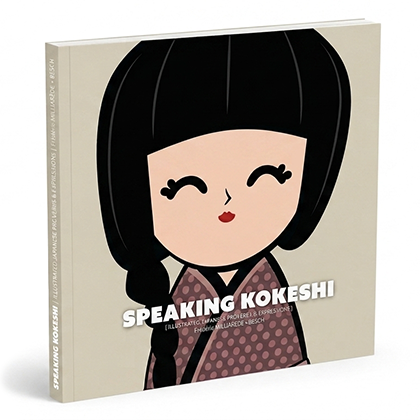
"Speaking Kokeshi" is a cultural project that combines visual elements of Japan 日本,
between kokeshi dolls こけし and proverbs (kotowaza) 諺, idioms, sayings, and lifestyle.
It is a collection of illustrated Japanese proverbs.
The collection started in May 2023.
New Kokeshi are published regularly.
The visuals are individually drawn.
The translation and explanation stem from research conducted to create the illustrations.
Literal: Literal : Ascending the Dragon Gate.
Meaning: A gateway to success; a competitive threshold that, once crossed, changes what you are.
The English phrase “ gateway to success ” is close, but it misses something. 「 tōryūmon 」 isn’t just any opening. It’s a specific kind of threshold, one that everyone in the room already recognizes as consequential, that separates what you were before from what you become after crossing it. The word keeps you at the entrance, not at the destination. That precision has a long history behind it.
The legend comes from China. Li Ying ((李膺 110–169) was a Han dynasty official known for recognizing talented scholars. Being acknowledged by him became a mark of prestige. And scholars were said to have “ passed through the Dragon Gate ”, a real and notoriously turbulent gorge on the Yellow River where, according to legend, any carp that leapt the waterfall would transform into a dragon. The image worked because it captured something precise: a change of nature, not just of position. You didn’t simply advance; you became something different.
That idea fit well with the Confucian ideal of meritocracy. For over a millennium, 「 kēju 」 (科挙), the imperial examination system, used the Dragon Gate as its emblematic image. A scholar of modest origins who passed the highest examinations crossed into a different social order entirely.
In contemporary Japan, it turns up wherever competitive selection is publicly understood to matter: university entrance exams, the corporate recruitment season known as 「 shūkatsu 」 (就活), auditions, bar exams, literary prizes. What the word implies is that the threshold is socially recognized, not privately constructed.
It names a gate that everyone can see.
Every spring, the 「 koinobori 」 (鯉のぼり), carp-shaped streamers flown for Children’s Day on May 5th, make the legend visible across Japan. Families fly one streamer per child, and the image of a carp straining against an invisible current says what the old legend always said: may this child have what it takes to leap the gate.
Many families display them without consciously thinking about dragons. The meaning travels anyway.
That quiet transmission might be the most interesting thing about this word. It names something every culture knows: a threshold that changes what you are.
Speaking Kokeshi#034 — A step that redefines you. — 登竜門
Speaking Kokeshi started in May 2023 from a simple observation: Japan has one of the richest traditions of proverbial expression in the world, and most of it is either unknown outside the country or reduced to a handful of pop concepts stripped of their context.
The original idea was to adapt the tradition of 19th-century European talking plates to modern times — objects that carried a phrase, a face, a moral. The kokeshi doll was the right vehicle. Spare, distinctive, rooted in Japanese craft, it allows the illustration to carry meaning without excess.
Forty proverbs. Forty characters. Each drawn individually, each the result of research into the cultural and historical origins of the expression. Not a catalog. A book with a point of view.