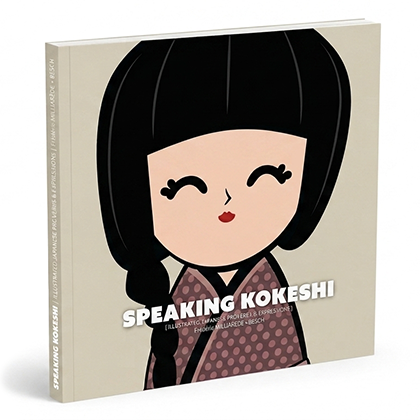
"Speaking Kokeshi" is a cultural project that combines visual elements of Japan 日本,
between kokeshi dolls こけし and proverbs (kotowaza) 諺, idioms, sayings, and lifestyle.
It is a collection of illustrated Japanese proverbs.
The collection started in May 2023.
New Kokeshi are published regularly.
The visuals are individually drawn.
The translation and explanation stem from research conducted to create the illustrations.
Literal: Worth of living.
Meaning: The particular reason, or constellation of reasons, that makes life feel worth living.
The word 「 ikigai 」 doesn’t translate neatly into English, which is probably why it has traveled so far. Break it down: 「 iki 」 (生き life or living) combined with 「 gai 」 (甲斐 worth, effect, something worth having). It doesn’t belong to Zen Buddhism, Confucianism, or Shinto exclusively. It runs through all three. References to something resembling the concept appear as far back as Heian period literature (794-1185), shaped by Buddhist ideas about impermanence and by Shinto’s sense of the sacred present in ordinary life. The concept of 「 mono no aware 」
(物の哀れ the bittersweet awareness that things pass) gave 「 ikigai 」 its particular weight. Because life is finite, what you choose to invest it in matters. Through the Edo period (1603-1868), urban artisans and merchants cultivated personal pursuits, calligraphy, poetry, tending a small garden, with no economic utility, understood as essential to a life well-lived. Ikigai, in that tradition, had nothing to do with productivity.
The four-question framework that circulates widely today, “ what you love ”, “ what you’re good at ”, “ what the world needs ”, “ what you can be paid for ”, is largely a Western invention, often misattributed to Japanese tradition. Scholars like Gordon Mathews have documented that the original concept is considerably more personal and modest: ikigai is a felt sense of purpose, frequently found in small, recurring things. A grandmother’s ikigai might be her grandchildren’s Sunday visits. A retired engineer’s might be his garden at dawn.
In contemporary Japan, the word moves between registers. It appears in public health campaigns targeting older populations, in corporate wellness discourse (which has absorbed some of the Western productivity framing, to the mild irritation of Japanese sociologists), and in discussions around 「 hikikomori 」 (引きこもり social withdrawal) as something whose absence explains a particular kind of suffering. Research on longevity in Okinawa, conducted as part of the “ Blue Zones ” studies, made ikigai internationally legible by connecting daily purpose to measurable health outcomes.
What Western readers tend to find in ikigai, once the four-circle diagram is set aside, is the gap it names:
the distance between a life that functions and a life that feels inhabited.
Speaking Kokeshi#039 — Meaning in the everyday. — 生き甲斐
Speaking Kokeshi started in May 2023 from a simple observation: Japan has one of the richest traditions of proverbial expression in the world, and most of it is either unknown outside the country or reduced to a handful of pop concepts stripped of their context.
The original idea was to adapt the tradition of 19th-century European talking plates to modern times — objects that carried a phrase, a face, a moral. The kokeshi doll was the right vehicle. Spare, distinctive, rooted in Japanese craft, it allows the illustration to carry meaning without excess.
Forty proverbs. Forty characters. Each drawn individually, each the result of research into the cultural and historical origins of the expression. Not a catalog. A book with a point of view.