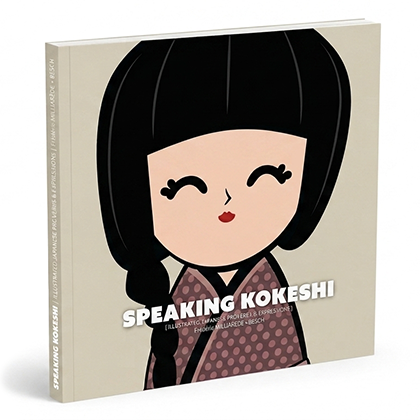
"Speaking Kokeshi" is a cultural project that combines visual elements of Japan 日本,
between kokeshi dolls こけし and proverbs (kotowaza) 諺, idioms, sayings, and lifestyle.
It is a collection of illustrated Japanese proverbs.
The collection started in May 2023.
New Kokeshi are published regularly.
The visuals are individually drawn.
The translation and explanation stem from research conducted to create the illustrations.
Literal: Crowd gathering panda.
Meaning: Something or someone used to attract attention or customers.
When China gifted two giant pandas to Japan in 1972, the queues at Ueno Zoo in Tokyo stretched for hours. Lan Lan and Kang Kang had arrived as part of a diplomatic gesture following the normalization of Sino-Japanese relations, and the country fell immediately, completely, in love. The panda became Japan’s most reliable crowd magnet overnight, and the language, as it tends to do, quietly absorbed this fact.
It belongs to a more recent layer of Japanese expression than the classical kotowaza rooted in Confucian ethics or Zen teachings. It belongs instead to a tradition of nimble, image-based phrases that crystallize around a shared cultural experience and harden, through repetition, into fixed idiom. Japanese has always been good at this: capturing social dynamics too specific, too textured, to describe in abstract terms.
What the expression captures so precisely is a particular kind of ambivalence. To call someone a 「 kyakuyose panda 」 is to acknowledge their drawing power while making clear they’re functioning, in this context, as bait.
It appears in business when a celebrity is hired to front a product launch, in politics when a popular figure heads a ticket to carry weaker candidates, in entertainment when a known name is attached to a film that wouldn’t otherwise sell. The person may be genuinely talented. That’s almost beside the point.
The suffix 「 yose 」 (寄せ gathering) reveals the mechanism: the warmth is instrumental.
Western cultures have rough equivalents. “ Crowd puller ”, “ draw ”, “ loss leader ” all gesture toward the same idea. But none holds the panda’s particular charge: an animal universally beloved, almost cartoonishly endearing, whose very softness makes the comparison sting slightly less.
You’re being used, yes, but as something everyone adores. That ambivalence, suspended without judgment in a single compound word, is what makes the expression untranslatable in any clean sense.
Speaking Kokeshi#014 — A star attraction. — 客寄せパンダ
Speaking Kokeshi started in May 2023 from a simple observation: Japan has one of the richest traditions of proverbial expression in the world, and most of it is either unknown outside the country or reduced to a handful of pop concepts stripped of their context.
The original idea was to adapt the tradition of 19th-century European talking plates to modern times — objects that carried a phrase, a face, a moral. The kokeshi doll was the right vehicle. Spare, distinctive, rooted in Japanese craft, it allows the illustration to carry meaning without excess.
Forty proverbs. Forty characters. Each drawn individually, each the result of research into the cultural and historical origins of the expression. Not a catalog. A book with a point of view.