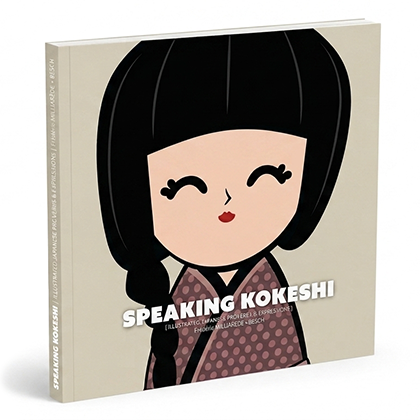
"Speaking Kokeshi" is a cultural project that combines visual elements of Japan 日本,
between kokeshi dolls こけし and proverbs (kotowaza) 諺, idioms, sayings, and lifestyle.
It is a collection of illustrated Japanese proverbs.
The collection started in May 2023.
New Kokeshi are published regularly.
The visuals are individually drawn.
The translation and explanation stem from research conducted to create the illustrations.
#009
While two fight, a third reaps the reward. 漁夫の利
漁夫の利 « Gyofu no ri »
Literal: The benefit of the fisherman.
Meaning: A conflict between two sides leads to the benefit of a third.
When a woodcock tried to devour a clam on the beach, its beak became trapped inside the shell of the mollusk. They were later found by a fisherman.
This one didn’t start in Japan. The image of the woodcock and the clam comes from the Zhanguo Ce (“ Strategies of the Warring States ”), a Chinese collection of political narratives compiled around the third century BCE. The story was a warning delivered to a king on the verge of attacking a weakened neighbor: while the two of you fight, someone else walks off with the prize. The fisherman doesn’t strategize. He just shows up at the right moment and picks up what’s there.
Japan absorbed the fable along with much of the classical Chinese literary canon, and the phrase settled into the language as a piece of political common sense. During the Edo period (1603-1868), when domain rivalries and merchant competition made the dynamic familiar at every level of society, the image would have needed no explanation.
In contemporary Japan, it is still very much alive, particularly in business. It gets invoked when a prolonged dispute between two competitors cracks open the market for a smaller player, or when an internal conflict inside a company creates an opening for whoever stayed out of it. The fisherman’s advantage is recognizable anywhere people compete, which is part of why the proverb traveled so well.
Western readers will place it immediately alongside “ when two quarrel, a third rejoices ”, a phrase with Latin roots that ran through European political writing for centuries. What the Japanese version adds, through the specific weight of its image, is something almost physical: the beak caught in the shell, two creatures locked together on the beach, neither able to move. The fisherman doesn’t need to be clever. He just needs to arrive.
Note: Seigaiha (Blue Ocean Waves) pattern. The waves of the sea, calm and quiet, but also powerful and resilient as they keep crashing incessantly on the shore. It’s also a symbol of rising good luck.
Speaking Kokeshi#009 — While two fight, a third reaps the reward. — 漁夫の利
Speaking Kokeshi started in May 2023 from a simple observation: Japan has one of the richest traditions of proverbial expression in the world, and most of it is either unknown outside the country or reduced to a handful of pop concepts stripped of their context.
The original idea was to adapt the tradition of 19th-century European talking plates to modern times — objects that carried a phrase, a face, a moral. The kokeshi doll was the right vehicle. Spare, distinctive, rooted in Japanese craft, it allows the illustration to carry meaning without excess.
Forty proverbs. Forty characters. Each drawn individually, each the result of research into the cultural and historical origins of the expression. Not a catalog. A book with a point of view.