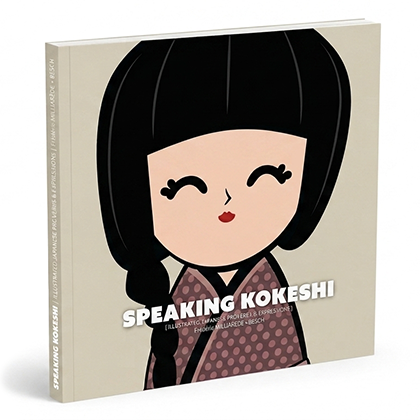
"Speaking Kokeshi" is a cultural project that combines visual elements of Japan 日本,
between kokeshi dolls こけし and proverbs (kotowaza) 諺, idioms, sayings, and lifestyle.
It is a collection of illustrated Japanese proverbs.
The collection started in May 2023.
New Kokeshi are published regularly.
The visuals are individually drawn.
The translation and explanation stem from research conducted to create the illustrations.
Literal: If you don’t enter the tiger’s cave, you can’t catch its cub.
Meaning: he greatest prize lies inside the greatest danger. You have to go in.
In 73 CE, Emperor Ming of the Eastern Han dynasty sent a small diplomatic mission into the Western Regions, the loose chain of kingdoms running along the Silk Road’s desert corridors. When it’s leader, Ban Chao and his thirty-six men arrived at the kingdom of Shanshan (now the Xinjiang Uyghur Autonomous Region), they were received warmly. A rival party from the Xiongnu, the nomadic confederation that had pressed against China’s northwestern borders for generations, had arrived at the same court, and the Shanshan king began quietly weighing his options. Ban Chao saw where this was heading: if the king sided with the Xiongnu, his men would almost certainly be handed over and killed. That night, Ban Chao rallied his party with the words “ If you do not enter the tiger’s den, you cannot take the tiger’s cubs ”. They launched a night raid, set fire to the Xiongnu tents, and killed the entire rival party. The next morning, Ban Chao placed the envoys’ heads before the Shanshan king. The king submitted to Han dynasty.
The proverb is not a story about optimism. Ban Chao knew where the danger was, calculated what was at stake, and chose to move toward it rather than wait for circumstance to make the decision for him. The image is strong at both ends, the visceral reality of entering the den, and the particular quality of what waits inside.
In Japanese, 「 koji 」 (虎子 tiger’s cub) carries a secondary meaning: something rare and precious, something guarded closely. The proverb is not simply about accepting risk. It places the most valuable thing at the center of the greatest danger and says you have to go there.
In contemporary Japan, the phrase moves easily from boardrooms to locker rooms. Startups invoke it before high-stakes launches. Coaches reach for it before key competitions. It turns up in career columns for graduates navigating a tight job market. What stays constant is the directionality: not blind courage, but a deliberate choice to move toward the source of the danger because that is precisely where the reward is.
Note: A counter-proverb is worth noting alongside it: 「 kunshi ayauki ni chikayorazu 」 (君子危うきに近寄らず the wise man does not approach danger). That both coexist in the same tradition without canceling each other out says something about how Japanese ethical thought tends to hold tensions rather than resolve them. Both are considered wisdom. Knowing which one fits your moment is the skill the tradition is actually asking you to cultivate.
Speaking Kokeshi#030 — Into the den. — 虎穴に入らずんば虎子を得ず
Speaking Kokeshi started in May 2023 from a simple observation: Japan has one of the richest traditions of proverbial expression in the world, and most of it is either unknown outside the country or reduced to a handful of pop concepts stripped of their context.
The original idea was to adapt the tradition of 19th-century European talking plates to modern times — objects that carried a phrase, a face, a moral. The kokeshi doll was the right vehicle. Spare, distinctive, rooted in Japanese craft, it allows the illustration to carry meaning without excess.
Forty proverbs. Forty characters. Each drawn individually, each the result of research into the cultural and historical origins of the expression. Not a catalog. A book with a point of view.