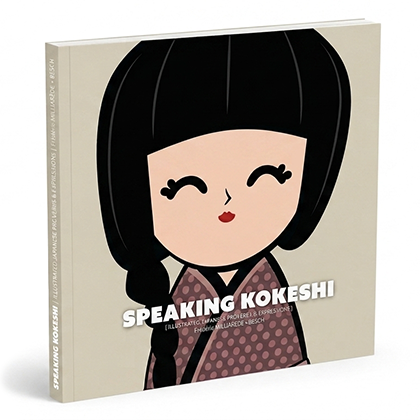
"Speaking Kokeshi" is a cultural project that combines visual elements of Japan 日本,
between kokeshi dolls こけし and proverbs (kotowaza) 諺, idioms, sayings, and lifestyle.
It is a collection of illustrated Japanese proverbs.
The collection started in May 2023.
New Kokeshi are published regularly.
The visuals are individually drawn.
The translation and explanation stem from research conducted to create the illustrations.
Literal: Ocean thousand, mountain thousand. For: A thousand years in the ocean, a thousand years in the mountains.
Meaning: A person so seasoned by long and varied experience that they have become shrewd, worldly-wise, and nearly impossible to deceive or outmaneuver.
There’s a kind of person you learn to recognize. They listen more than they speak. In a negotiation they already seem to know what you’re about to say. They’ve seen enough versions of the same human game that nothing quite throws them.
The image comes from a strand of Japanese folklore in which certain creatures, serpents especially, were said to accumulate extraordinary power through sheer longevity and radical change of environment. A being that had survived the ocean’s depths and then the mountain’s heights had moved through worlds different enough to become something harder to read, harder to trap. When this idea filtered into everyday language, the mythological creature became a human type: the person whose long exposure to difficulty, deception, and change has made them both wiser and, frankly, a little harder to pin down. The expression isn’t simply a compliment. Someone called 「 umi sen yama sen 」 earns respect, but also a degree of wariness.
There’s cunning in there alongside experience, and that ambivalence feels very Edo-period (1603-1868) in its logic: practical shrewdness was valued in merchant culture, but the Confucian framework that organized social life didn’t exactly encourage you to advertise it. You could be clever. You just weren’t supposed to say so.
Today in Japan the phrase surfaces mostly in professional settings: the veteran negotiator too seasoned to be rattled, the senior colleague whose calm during a crisis comes from having already lived through two or three of them. It shows up in family life too, with a certain wry affection, when adult children realize a parent had understood the situation long before anyone admitted it out loud.
For a Western reader, what’s striking is what the proverb implies about experience and character. The Anglo-American tradition tends to idealize the wisdom of age in softer terms: the mentor, the trusted elder. It describes something less comfortable. A person shaped by enough of life’s less flattering mechanics that they genuinely can’t be fooled. “ Old fox ” gets close in spirit, but it doesn’t carry the same weight. The thousand years matter. They’re there to say: this kind of knowledge doesn’t come quickly, and it can’t be faked.
Speaking Kokeshi#025 — Hard to read, harder to fool. — 死人に口なし
Speaking Kokeshi started in May 2023 from a simple observation: Japan has one of the richest traditions of proverbial expression in the world, and most of it is either unknown outside the country or reduced to a handful of pop concepts stripped of their context.
The original idea was to adapt the tradition of 19th-century European talking plates to modern times — objects that carried a phrase, a face, a moral. The kokeshi doll was the right vehicle. Spare, distinctive, rooted in Japanese craft, it allows the illustration to carry meaning without excess.
Forty proverbs. Forty characters. Each drawn individually, each the result of research into the cultural and historical origins of the expression. Not a catalog. A book with a point of view.