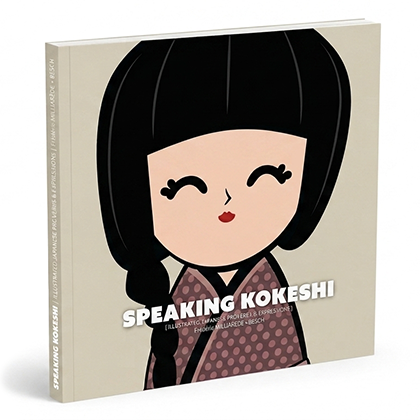
"Speaking Kokeshi" is a cultural project that combines visual elements of Japan 日本,
between kokeshi dolls こけし and proverbs (kotowaza) 諺, idioms, sayings, and lifestyle.
It is a collection of illustrated Japanese proverbs.
The collection started in May 2023.
New Kokeshi are published regularly.
The visuals are individually drawn.
The translation and explanation stem from research conducted to create the illustrations.
Literal: One stone two birds.
Meaning: To achieve two objectives with the same action.
Of all the proverbs in this collection, this one might feel the most familiar to Western readers, and for good reason: it is almost certainly a translation of the English “ killing two birds with one stone ”, absorbed into Japanese during the Meiji era (1868-1912), when the country was pulling in Western ideas at speed and finding Japanese shapes for them. The phrase was already well established in English long before Japan opened its doors to the West: its first recorded appearance dates to 1656, in Thomas Hobbes’s The Questions Concerning Liberty, Necessity, and Chance. By the time Meiji scholars were translating Western texts at speed, the image of the stone and the two birds had been in circulation for over two centuries.
What’s interesting is how completely the phrase has settled in. There’s no sense of foreignness to it now, no trace of its probable origins. It behaves like something that was always there, compact and imagistic and immediately understood. Japan has a long history of taking what it finds useful and making it unrecognizably its own, from Chinese classical thought in the Nara period to Western technology in the Meiji. The language carries that history quietly, in ways speakers rarely stop to examine.
In Japan today, it is used lightly, almost cheerfully. It describes the satisfying efficiency of a well-planned errand, a business move that solves two problems at once, a gift that doubles as an apology. It carries no moral weight, no warning. It just names a pleasant thing: the moment when one action turns out to be worth two.
Western readers will land on it without effort, which is exactly what makes it worth pausing over. The shared image, stone and birds, points to something universal enough to produce the same metaphor independently, or to travel across a language barrier and take root without resistance. Some ideas don’t need much translation.
Note: Same Komon Pattern. This is a purely artistic pattern. It is also called Shark Skin in Japan due to its small dots and arc-shaped lines.
Speaking Kokeshi#011 — Killing two birds with one stone. — 一石二鳥
Speaking Kokeshi started in May 2023 from a simple observation: Japan has one of the richest traditions of proverbial expression in the world, and most of it is either unknown outside the country or reduced to a handful of pop concepts stripped of their context.
The original idea was to adapt the tradition of 19th-century European talking plates to modern times — objects that carried a phrase, a face, a moral. The kokeshi doll was the right vehicle. Spare, distinctive, rooted in Japanese craft, it allows the illustration to carry meaning without excess.
Forty proverbs. Forty characters. Each drawn individually, each the result of research into the cultural and historical origins of the expression. Not a catalog. A book with a point of view.