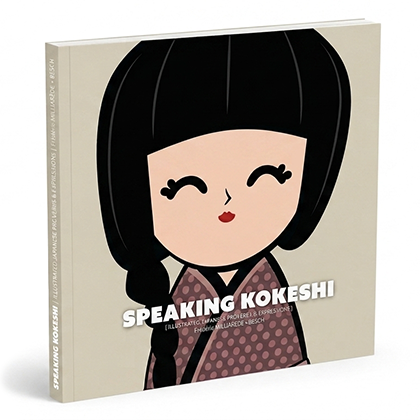
"Speaking Kokeshi" is a cultural project that combines visual elements of Japan 日本,
between kokeshi dolls こけし and proverbs (kotowaza) 諺, idioms, sayings, and lifestyle.
It is a collection of illustrated Japanese proverbs.
The collection started in May 2023.
New Kokeshi are published regularly.
The visuals are individually drawn.
The translation and explanation stem from research conducted to create the illustrations.
A second version of encouragement, pop culture-oriented.
The goal here is to offer this poster to someone who is starting or has already begun a project to show them your support. In the box at the bottom, along the blue line, they note the project start date on the left, their project in the center, and then color one of the eyes black (whichever one they choose). Once the project is completed, they will paint the second eye and indicate the project completion date in the box at the bottom.
The idea comes from Daruma, which are small papier-mâché figurines. These are good luck charms, existing somewhere between magic, psychology, and primarily spirituality. These talismans support the realization of a project, which can be personal, professional, athletic, creative, or group-oriented.
The concepts of personal growth and success are evoked by the Koinobori, and encouragement is conveyed with a «Ganbatte!», an expression deeply rooted in Japanese culture.
So, why not make a graphical version that can be kept as a memento, both of the project and the connection with the person who offered it?
Speaking Kokeshi started in May 2023 from a simple observation: Japan has one of the richest traditions of proverbial expression in the world, and most of it is either unknown outside the country or reduced to a handful of pop concepts stripped of their context.
The original idea was to adapt the tradition of 19th-century European talking plates to modern times — objects that carried a phrase, a face, a moral. The kokeshi doll was the right vehicle. Spare, distinctive, rooted in Japanese craft, it allows the illustration to carry meaning without excess.
Forty proverbs. Forty characters. Each drawn individually, each the result of research into the cultural and historical origins of the expression. Not a catalog. A book with a point of view.