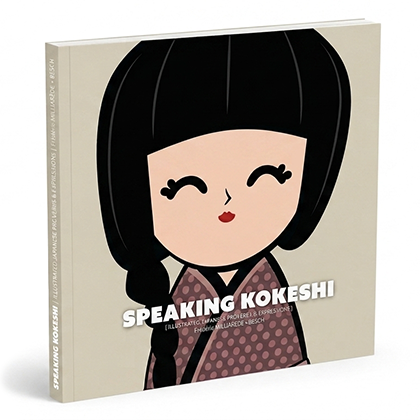
"Speaking Kokeshi" is a cultural project that combines visual elements of Japan 日本,
between kokeshi dolls こけし and proverbs (kotowaza) 諺, idioms, sayings, and lifestyle.
It is a collection of illustrated Japanese proverbs.
The collection started in May 2023.
New Kokeshi are published regularly.
The visuals are individually drawn.
The translation and explanation stem from research conducted to create the illustrations.
Literal: Extremely wicked and cruel.
Meaning: An individual or action that has fundamentally rejected the moral order, acting with a total disregard for empathy or human decency.
There’s a precision to the Japanese moral vocabulary that translation rarely captures cleanly. It doesn’t just name evil: it places it. The character 「 hi 」 (非) means negation, transgression, the crossing of a line that shouldn’t be crossed. And 「 dō 」 (道) is the Way, the moral order that holds human relations together.
To be 「 gokuaku hidō 」 is to have stepped fully outside that order, not merely to have done something terrible but to have severed yourself from the ethical fabric that makes community possible in the first place.
The expression belongs to the world of 「 yojijukugo 」 (四字熟語 four-character compounds), those dense literary forms borrowed from classical Chinese through the scholarly 「 kanbun 」 (漢文 classical Chinese writing) tradition. Their compressed structure made them natural instruments for moral judgment. The 「 dō 」 道 at the core of this one draws from both Taoist and Confucian thought. In Confucianism, the Way governs right relationships between ruler and subject, parent and child, teacher and student. To violate those relationships wasn’t simply a social offense. It was a disruption of the cosmic order itself.
In contemporary Japan, it shows up in courtrooms, crime journalism, and popular media. Manga and anime have given it a theatrical afterlife, deploying it for archetypal villains in ways that have softened its edges a little in younger usage. In legal and journalistic contexts, though, the full weight remains: it gets applied to war crimes, systematic abuse, serial violence. The expression lives at the junction of ancient ethical vocabulary and present-day outrage, and that tension is precisely what gives it its rhetorical force. It sounds like both a verdict and a judgment beyond appeal.
What it captures with unusual clarity is the relational nature of the transgression. This isn’t just bad behavior, it’s a rejection of the shared moral ground that makes society possible. Where Western ethical language tends to frame extreme evil as an individual falling, a sin, a pathology, the Japanese formulation frames it as something larger. A breaking of the world.
Speaking Kokeshi#019 — Beyond the point of no return. — 極悪非道
Speaking Kokeshi started in May 2023 from a simple observation: Japan has one of the richest traditions of proverbial expression in the world, and most of it is either unknown outside the country or reduced to a handful of pop concepts stripped of their context.
The original idea was to adapt the tradition of 19th-century European talking plates to modern times — objects that carried a phrase, a face, a moral. The kokeshi doll was the right vehicle. Spare, distinctive, rooted in Japanese craft, it allows the illustration to carry meaning without excess.
Forty proverbs. Forty characters. Each drawn individually, each the result of research into the cultural and historical origins of the expression. Not a catalog. A book with a point of view.