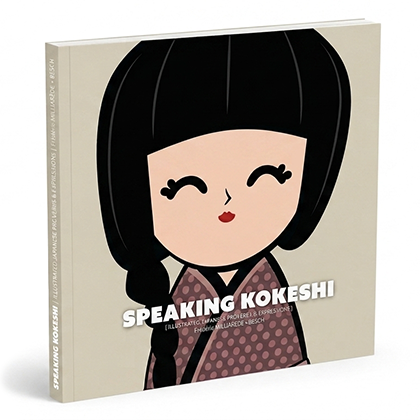
"Speaking Kokeshi" is a cultural project that combines visual elements of Japan 日本,
between kokeshi dolls こけし and proverbs (kotowaza) 諺, idioms, sayings, and lifestyle.
It is a collection of illustrated Japanese proverbs.
The collection started in May 2023.
New Kokeshi are published regularly.
The visuals are individually drawn.
The translation and explanation stem from research conducted to create the illustrations.
#001
Avoid stating your abilities without reason. 能ある鷹は爪を隠す
能ある鷹は爪を隠す « No aru taka ha tsume wo kakusu »
Literal: The hawk with talents hides its talons.
Meaning: Don’t show your skills without purpose.
The hawk in this proverb is not humble. It is precise. Its talons, capable of killing, stay folded away, not from timidity, but from a mastery so complete it no longer needs to announce itself.
That distinction matters: this proverb does not counsel self-effacement. It describes the deliberate economy of those who have nothing left to prove.
The image draws on a long culture of 「 takagari 」 (鷹狩り falconry), a practice that shaped aristocratic and samurai life from the Nara period onward and remained a mark of prestige well into the Edo era (1603–1868).
When the Tokugawa shogunate codified Confucian ethics across all social strata, 「 kenkyō 」 (謙虚, the virtue of restraint and modesty) became central to educated conduct.
To display one’s talents was not merely impolite: it signaled incomplete formation, the way a craftsman waving his tools in the street would. The social logic ran in one direction: the more genuine the competence, the less it seeks to announce itself. Writing at the turn of the twentieth century, Nitobe Inazō identified this restraint as foundational to Japanese moral life, distinct from Western Christian humility in that it carries no theological weight. It is, he argued, a question of form and inner discipline.
In Japan today, the phrase surfaces reliably in professional settings, sometimes as quiet praise (“ he’s someone who hides his talons ”), sometimes as a gentle corrective when someone is seen as overreaching. Younger generations navigating international careers feel a specific friction here: the self-promotional demands of Western-style interviews sit awkwardly against a deeply internalized instinct for restraint. The proverb doesn’t resolve that tension. It names it.
Western readers will find something familiar, but also a gap. English has its own suspicion of display (“ empty vessels make the most noise ”). But that’s a negative formulation: don’t boast. The Japanese proverb does something else. It frames silence as the active signature of capability. What the hawk conceals is not weakness. It is the proof.
Note: the kanji 謙 on the 「 dōgi 」 (martial arts training uniform) means “ be modest ”. It’s a strength, but can be a strategy too.
Speaking Kokeshi#001 — Avoid stating your abilities without reason. — 能ある鷹は爪を隠す
Speaking Kokeshi started in May 2023 from a simple observation: Japan has one of the richest traditions of proverbial expression in the world, and most of it is either unknown outside the country or reduced to a handful of pop concepts stripped of their context.
The original idea was to adapt the tradition of 19th-century European talking plates to modern times — objects that carried a phrase, a face, a moral. The kokeshi doll was the right vehicle. Spare, distinctive, rooted in Japanese craft, it allows the illustration to carry meaning without excess.
Forty proverbs. Forty characters. Each drawn individually, each the result of research into the cultural and historical origins of the expression. Not a catalog. A book with a point of view.