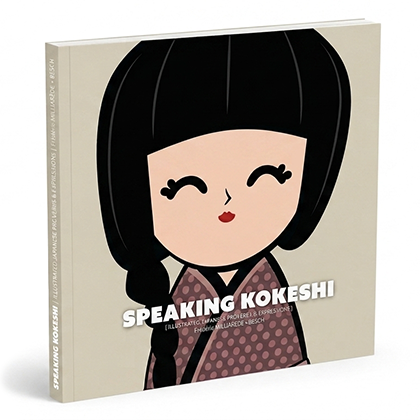
"Speaking Kokeshi" is a cultural project that combines visual elements of Japan 日本,
between kokeshi dolls こけし and proverbs (kotowaza) 諺, idioms, sayings, and lifestyle.
It is a collection of illustrated Japanese proverbs.
The collection started in May 2023.
New Kokeshi are published regularly.
The visuals are individually drawn.
The translation and explanation stem from research conducted to create the illustrations.
Literal: Literal: Not speaking is a flower.
Meaning: Sometimes silence is better than speaking.
The choice of 「 hana 」 (花 flower) is not decorative. In Japan, a flower doesn’t just signal beauty: it signals the right moment, and then the letting go. Zeami Motokiyo (1363–1443), the great Noh theater master, used this same word to describe what makes a performance unforgettable “only after an actor … will have practiced assiduously and mastered the various necessary techniques will he be able to grasp the principle of a flower that does not fade ”. Not what the actor shows, but what he chooses to withhold. A proverb about silence reaches for this exact word is not a coincidence. See #029.
It is hard to date it precisely, but its sensibility belongs to a long current in Japanese thought that treats the unexpressed as a form of presence rather than absence. Zen practice, built around 「 mu 」 (無 emptiness or nothingness), trained people to find meaning in what was left out. 「 Ma 」 (間 the pause, the gap between things) became an organizing principle across architecture, music, and conversation. Silence, in this frame, is not a failure to speak. It is its own kind of statement. Matsuo Bashō’s haiku operate on exactly this principle: the image is placed, the meaning withheld, and the reader fills what remains.
In contemporary Japan, the proverb surfaces most naturally in situations where honesty would cost more than it gains. The ability to read a room, captured in the expression 「 kuuki wo yomu 」 (空気を読む literally “ reading the air ”), is considered a basic social skill. Saying the true thing at the wrong moment, or with more completeness than necessary, marks someone as clumsy. In family settings too, the proverb governs what parents choose not to say to adult children, and what adult children choose not to say back. It is less a warning than a reminder of what elegance actually looks like.
Western readers might reach for “ silence is golden ”, but that comparison misses something. “ Silence is golden ”
counsels restraint, usually against gossip or conflict. This proverb calls silence beautiful. That gap is not just semantic. It reflects a different relationship with the unsaid. What remains unspoken does not disappear, but continues to exist, like a flower, with its own quiet presence.
Speaking Kokeshi#004 — It's wise to remain silent. — 言わぬが花
Speaking Kokeshi started in May 2023 from a simple observation: Japan has one of the richest traditions of proverbial expression in the world, and most of it is either unknown outside the country or reduced to a handful of pop concepts stripped of their context.
The original idea was to adapt the tradition of 19th-century European talking plates to modern times — objects that carried a phrase, a face, a moral. The kokeshi doll was the right vehicle. Spare, distinctive, rooted in Japanese craft, it allows the illustration to carry meaning without excess.
Forty proverbs. Forty characters. Each drawn individually, each the result of research into the cultural and historical origins of the expression. Not a catalog. A book with a point of view.