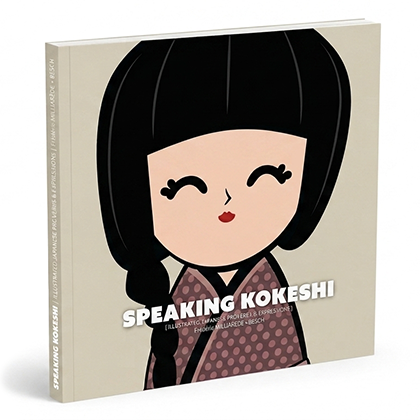
"Speaking Kokeshi" is a cultural project that combines visual elements of Japan 日本,
between kokeshi dolls こけし and proverbs (kotowaza) 諺, idioms, sayings, and lifestyle.
It is a collection of illustrated Japanese proverbs.
The collection started in May 2023.
New Kokeshi are published regularly.
The visuals are individually drawn.
The translation and explanation stem from research conducted to create the illustrations.
Literal: If you are in a hurry, take the roundabout way.
Meaning: Avoid rushing blindly and proceed thoughtfully to avoid having to start over completely.
At 「 Seta 」 (瀬田), on Kyoto’s eastern edge, a bridge spans the southern tip of Lake Biwa. Long, inconvenient, and to a traveler in a hurry, something that must have felt like the wrong choice. The quicker option was the ferry at 「 Yabuse 」 (矢橋), cutting straight across. But Lake Biwa in storm season is unforgiving, and a boat caught mid-crossing could cost far more than the few minutes saved. That very real dilemma gave birth to this phrase. It is most commonly attributed to Sōchō (1448-1532) a renga master (collaborative form of Japanese poetry).
The Edo period lifted it out of that landscape and turned it into a principle. The 「 chōnin 」 (町人) merchant culture, shaped by Confucian ideals of steady effort, found in it a practical ethics. Rushing a trade or a craft tends to produce mistakes that take longer to correct than the shortcut saved. It circulated not as poetry but as working advice, passed from master to apprentice.
In Japan today, it still earns its keep in professional and educational settings, often as a quiet corrective. Teachers invoke it when students rush through problems without reading them properly. There are conversations around 「 karōshi 」 (過労死 death from overwork) where it surfaces as an argument that sustainable pace is not weakness but good sense. The proverb carries enough authority to be used in those debates without sounding naive.
Western readers will recognize cousins the Latin “ festina lente ” (make haste slowly), the English “ more haste, less speed ”. What those lack is the texture of the Japanese version. A lake, two routes, a storm that may or may not come. The prudence here was learned from experience.
Note. 迷 on the kimono means to get lost, to wander.
Mameshibori Pattern. this term literally means “ compressed bean ”. It is characterized by small dots arranged at regular intervals. Originally, it referred to a dyed pattern consisting of small dark blue dots on a white background or white dots on a dark blue background. Each circle, created using the shibori technique, exhibits variations in color and shape. 「 mame 」 (bean) also shares the same pronunciation as a term meaning “ to have a resilient body, to work with diligence ”. Since many beans can be grown from just one bean, it also encompasses the meaning of “ a prayer for prosperity ”.
Speaking Kokeshi#037 — Slow is smooth, smooth is fast. — 急がば回れ
Speaking Kokeshi started in May 2023 from a simple observation: Japan has one of the richest traditions of proverbial expression in the world, and most of it is either unknown outside the country or reduced to a handful of pop concepts stripped of their context.
The original idea was to adapt the tradition of 19th-century European talking plates to modern times — objects that carried a phrase, a face, a moral. The kokeshi doll was the right vehicle. Spare, distinctive, rooted in Japanese craft, it allows the illustration to carry meaning without excess.
Forty proverbs. Forty characters. Each drawn individually, each the result of research into the cultural and historical origins of the expression. Not a catalog. A book with a point of view.