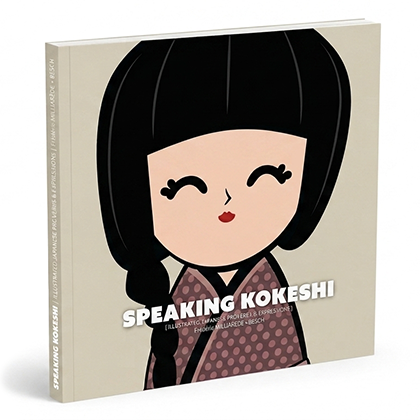
"Speaking Kokeshi" is a cultural project that combines visual elements of Japan 日本,
between kokeshi dolls こけし and proverbs (kotowaza) 諺, idioms, sayings, and lifestyle.
It is a collection of illustrated Japanese proverbs.
The collection started in May 2023.
New Kokeshi are published regularly.
The visuals are individually drawn.
The translation and explanation stem from research conducted to create the illustrations.
#017
There is no such thing as a “small mistake”. 一事が万事
一事が万事 « ichiji ga banji »
Literal: From one thing, 10,000 things.
Meaning: A diagnostic warning about character and consistency. A single instance, behavior, or detail can be used to judge the whole.
There’s a particular kind of attention embedded in it that Western languages rarely name directly. It doesn’t describe how people form impressions. It describes something closer to a law: the detail reveals the whole, and the whole was always there in the detail.
The philosophical roots run deep. Confucian ethics, which shaped Japanese moral thinking from at least the Heian period onward, held that character isn’t something a person switches on depending on the stakes. The Analects of Confucius return repeatedly to this idea. That behavior in trivial situations is the truest indicator of a person’s moral virtue, precisely because it’s unguarded. Buddhist thought added another layer through 「 engi 」 (縁起 dependent origination), the doctrine that no phenomenon exists in isolation. Applied to human conduct, this means a single action is never truly isolated: it participates in a pattern that patient observation can read. By the Edo period, this logic had migrated from temple texts into merchant codes and the practical ethics of daily commerce, where reputation built slowly and could fracture overnight.
In Japan today, the proverb surfaces most often in professional environments. A single late delivery, an overlooked detail in a proposal, a careless message in a group chat: in a working culture where 「 shinrai 」 (信頼 trust) accumulates through small, consistent proofs of reliability, any of these can shift how a person is read entirely. It also appears in family and educational settings, where it functions less as a spoken warning than as a standard quietly applied to children long before they’re conscious of being measured.
What makes this phrase resonate for a Western reader is precisely what’s missing from its nearest equivalents. “ First impressions count ” is about optics. 「 ichiji ga banji 」 is a claim about structure: the part is already the whole. That’s a harder idea, and a more honest one.
Speaking Kokeshi#017 — There is no such thing as a “small mistake”. — 一事が万事
Speaking Kokeshi started in May 2023 from a simple observation: Japan has one of the richest traditions of proverbial expression in the world, and most of it is either unknown outside the country or reduced to a handful of pop concepts stripped of their context.
The original idea was to adapt the tradition of 19th-century European talking plates to modern times — objects that carried a phrase, a face, a moral. The kokeshi doll was the right vehicle. Spare, distinctive, rooted in Japanese craft, it allows the illustration to carry meaning without excess.
Forty proverbs. Forty characters. Each drawn individually, each the result of research into the cultural and historical origins of the expression. Not a catalog. A book with a point of view.