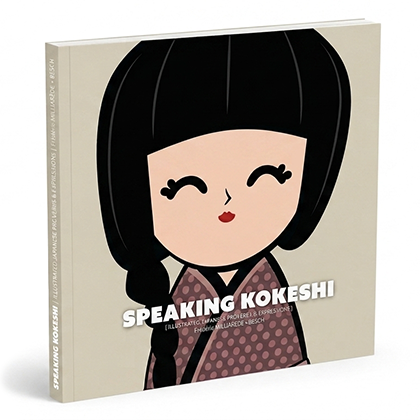
"Speaking Kokeshi" is a cultural project that combines visual elements of Japan 日本,
between kokeshi dolls こけし and proverbs (kotowaza) 諺, idioms, sayings, and lifestyle.
It is a collection of illustrated Japanese proverbs.
The collection started in May 2023.
New Kokeshi are published regularly.
The visuals are individually drawn.
The translation and explanation stem from research conducted to create the illustrations.
金は火に試され、人は酒に試される 「 Kin wa hi ni tamesare, hito wa sake ni tamesareru 」
Literal: Gold is tested by fire, people are tested by sake.
Meaning: Drunkenness reveals the true face of people.
It doesn’t frame drunkenness as weakness or embarrassment, it frames it as a test. Gold goes into the fire not to be destroyed but to be read. It isn’t just about drinking, it’s about revealing true character under certain conditions.
That framing is very Japanese. Social life in Japan has long been shaped by the gap between 「 honne 」
(本音 what you actually feel) and 「 tatemae 」 (建前 what you show in public). This isn’t about dishonesty. It’s closer to a necessary architecture, a way of keeping group life functional.
Confucian ethics, which ran deep in Japanese society through the Edo period (1603-1868), placed enormous value on restraint and decorum in public settings. Sake offered a legitimate exit from that. The 「 nomikai 」
(飲み会 the group drinking gathering) became precisely the space where the mask could slip without permanent damage. The proverb likely took root in that cultural moment.
Sake was already loaded with significance long before it became a social ritual. In Shinto practice (Japan’s indigenous tradition, built not on doctrine but on relationships with 「 kami 」 (神), the spirits believed to inhabit natural places, objects, and ancestors), sake was offered at shrines and shared at festivals as a way of communing with those forces. A substance that crossed thresholds between the human and the divine long before the
「 izakaya 」 (居酒屋 the Japanese pub) existed.
Today, the obligatory 「 nomikai 」 is losing its grip. Younger Japanese drink less, and many openly resist the expectation of after-work drinks with the boss. But the proverb holds, if anything, it’s sharper now, because what it describes is being examined rather than quietly accepted. Any public figure caught behaving badly while drunk will find this proverb surfacing almost immediately in the coverage.
The Latin “ in vino veritas ” gets at something similar. But the metallurgical image here carries more weight. The fire doesn’t damage the gold, it clarifies it.
Note: 酒 sake ideogram.
Speaking Kokeshi#012 — What lies within. — 金は火に試され、人は酒に試される
Speaking Kokeshi started in May 2023 from a simple observation: Japan has one of the richest traditions of proverbial expression in the world, and most of it is either unknown outside the country or reduced to a handful of pop concepts stripped of their context.
The original idea was to adapt the tradition of 19th-century European talking plates to modern times — objects that carried a phrase, a face, a moral. The kokeshi doll was the right vehicle. Spare, distinctive, rooted in Japanese craft, it allows the illustration to carry meaning without excess.
Forty proverbs. Forty characters. Each drawn individually, each the result of research into the cultural and historical origins of the expression. Not a catalog. A book with a point of view.