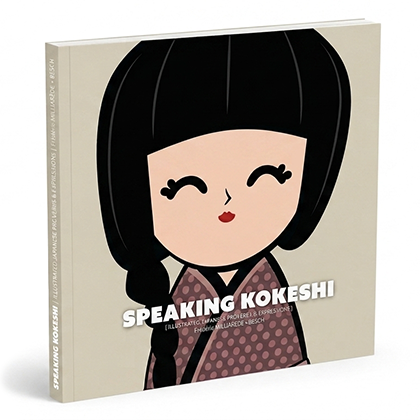
"Speaking Kokeshi" is a cultural project that combines visual elements of Japan 日本,
between kokeshi dolls こけし and proverbs (kotowaza) 諺, idioms, sayings, and lifestyle.
It is a collection of illustrated Japanese proverbs.
The collection started in May 2023.
New Kokeshi are published regularly.
The visuals are individually drawn.
The translation and explanation stem from research conducted to create the illustrations.
Literal: Even warts turn into dimples.
Meaning: When you love someone, even their flaws can look endearing.
The proverb makes visceral sense the moment you know where it comes from. Smallpox, 「 tōsō 」 (痘瘡), swept through Japan in recurring waves for over a millennium, and the scars it left, 「 abata 」 (痘痕), were not some rare misfortune. They were a near-universal mark, worn by emperors and rice farmers alike, written permanently into the faces of survivors. Against that backdrop, the claim that love could turn those scars into 「 ekubo 」 (靨), the small hollows in a cheek long considered charming in Japanese aesthetics, was not a gentle metaphor.
It was a fairly radical observation about what feeling does to sight.
The proverb’s closest Western equivalent, “ love is blind ” goes back at least to Shakespeare, and beyond him into classical tradition. But the two sayings describe different things. “ Love is blind ” proposes a failure of vision: the lover simply doesn’t see. This proverb describes an active conversion. The eye still works. The pockmark doesn’t vanish; it becomes a dimple. That distinction is small on the surface and considerable underneath.
It resonates with strands of Buddhist thought that shaped Japanese popular culture from the Kamakura period (cultural and religious turning point starting in the late 12th century) onward, particularly the understanding that what we perceive as the fixed quality of a thing, its beauty or its ugliness, is partly a projection of the mind doing the looking. The proverb doesn’t present this as wisdom to be cultivated. It presents it as something that simply happens when you love someone.
Today in Japan, the saying moves easily across contexts. It shows up in conversations about romance, of course, but also in wry observations about devotion to an employer: the kind of loyalty that makes you find the familiar flaws of your 「 kaisha 」 (会社, company) almost endearing rather than maddening. It can be said with genuine warmth or with a knowing half-smile, depending on the speaker.
What it gives a Western reader is a more precise vocabulary for something we know but tend to name poorly. Calling love blind frames the thing as a deficit, a malfunction. The Japanese version is more honest about the mechanism: the flaw is still there, fully visible, and it has become something beautiful. That’s a different claim entirely, and, if you sit with it, a more unsettling one.
Speaking Kokeshi started in May 2023 from a simple observation: Japan has one of the richest traditions of proverbial expression in the world, and most of it is either unknown outside the country or reduced to a handful of pop concepts stripped of their context.
The original idea was to adapt the tradition of 19th-century European talking plates to modern times — objects that carried a phrase, a face, a moral. The kokeshi doll was the right vehicle. Spare, distinctive, rooted in Japanese craft, it allows the illustration to carry meaning without excess.
Forty proverbs. Forty characters. Each drawn individually, each the result of research into the cultural and historical origins of the expression. Not a catalog. A book with a point of view.