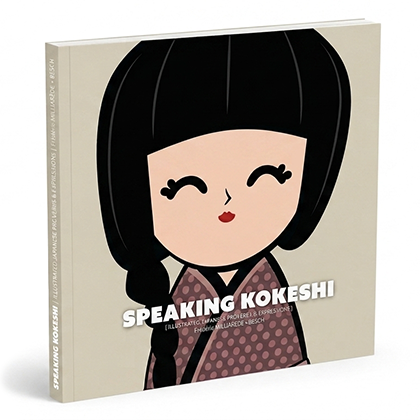
"Speaking Kokeshi" is a cultural project that combines visual elements of Japan 日本,
between kokeshi dolls こけし and proverbs (kotowaza) 諺, idioms, sayings, and lifestyle.
It is a collection of illustrated Japanese proverbs.
The collection started in May 2023.
New Kokeshi are published regularly.
The visuals are individually drawn.
The translation and explanation stem from research conducted to create the illustrations.
Literal: If with a fool you compete, are you not a fool?
Meaning: Engaging with foolish people only drags you down; by treating nonsense as a serious debate, you become part of the problem.
There is a trap built into the proverb itself. To argue against it is to prove it. It’s rhetorical structure functions as a small closed loop: the question it poses cannot be answered without the answer implicating the speaker.
The word 「 aho 」 (あほ fool) carries significant regional flavor in Japanese. In the Kansai dialect, centered on Osaka and Kyoto, it tends toward the affectionate or comic; in Tokyo Japanese, its near-equivalent 「 baka 」 (馬鹿) carries more sting. That this proverb uses both, positioning 「 baka 」 as the fate awaiting those who engage too readily with 「 aho 」, suggests an origin in the Kansai oral tradition, where wordplay and comic self-awareness were cultivated with particular care. The doubling lands like a punchline: the fool is named in the first half, and the person who rises to the bait becomes the second kind of fool by the final word.
Philosophically, the proverb has clear relatives in the Buddhist concept of 「 fushō 」 (不諍 non-contention), the idea that wisdom avoids unnecessary conflict not out of weakness but from the recognition that some exchanges produce no light. Confucian thought reinforces this from a different angle. The 「 kunshi 」 (君子 the cultivated person) is defined partly by whom he chooses not to address. In both traditions, discernment about where to place your attention is itself a form of intelligence.
In contemporary Japan, the proverb surfaces most visibly in conversations about online behavior. The phrase 「 surū suru 」 (スルーする to ignore, borrowed from the English «through») has become standard social advice, and this proverb sits behind much of that culture. The wisdom of not feeding what doesn’t deserve feeding. The fool needs friction to function as a fool. Engaging elevates. Ignoring deflates.
English comes close with “ never argue with a fool, onlookers may not be able to tell the difference ”, a formula that mirrors the Japanese almost exactly in structure and in sting.
Speaking Kokeshi#023 — Only a fool deals with a fool. — あほに取り合うばか
Speaking Kokeshi started in May 2023 from a simple observation: Japan has one of the richest traditions of proverbial expression in the world, and most of it is either unknown outside the country or reduced to a handful of pop concepts stripped of their context.
The original idea was to adapt the tradition of 19th-century European talking plates to modern times — objects that carried a phrase, a face, a moral. The kokeshi doll was the right vehicle. Spare, distinctive, rooted in Japanese craft, it allows the illustration to carry meaning without excess.
Forty proverbs. Forty characters. Each drawn individually, each the result of research into the cultural and historical origins of the expression. Not a catalog. A book with a point of view.