Passer en français
Speaking Kokeshi — Illustrated Japanese Proverbs

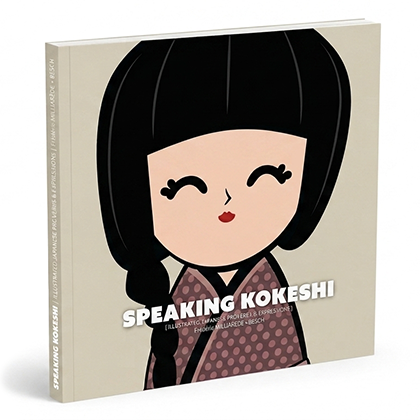
"Speaking Kokeshi" is a cultural project that combines visual elements of Japan 日本,
between kokeshi dolls こけし and proverbs (kotowaza) 諺, idioms, sayings, and lifestyle.
It is a collection of illustrated Japanese proverbs.
The collection started in May 2023.
New Kokeshi are published regularly.
The visuals are individually drawn.
The translation and explanation stem from research conducted to create the illustrations.
No AI or whateverGPT.

ILLUSTRATED JAPANESE PROVERBS

#006 There is no great genius without a mixture of madness. 天才と狂人は紙一重

Speaking Kokeshi #006 — There is no great genius without a mixture of madness. 天才と狂人は紙一重 « tensai to kyôjin wa kami hitoe »

天才と狂人は紙一重
« tensai to kyôjin wa kami hitoe »

Literal: There is only a sheet of paper between a genius and a madman.
Meaning: Extraordinary creativity can be perceived as madness by others.

The proverb doesn’t say genius and madness are the same thing. It says the distance between them is the thickness of a sheet of paper. That precision matters.

「 Kami hitoe 」 (紙一重) is a fixed expression in Japanese meaning a hair’s breadth, the narrowest possible margin, and it appears in other contexts too: a victory decided by kami hitoe, a life saved by kami hitoe. The image is always one of an almost invisible boundary between two very different outcomes.
Japan’s relationship with this particular boundary has its own texture. The figure of the artist or poet whose intensity tipped into something socially unreadable recurs throughout Japanese cultural history. The calligrapher who worked until he couldn’t stop. The poet who withdrew from the world entirely. The Zen monk whose behavior made no sense to anyone outside the monastery and perfect sense inside it. These figures were not always admired in their lifetimes, but the culture developed a retrospective tenderness toward them, a willingness to reframe what once looked like dysfunction as the necessary cost of vision.

The proverb likely gained traction during the Meiji period (1868–1912), when Japan absorbed Western psychiatric concepts and the word 「 kyôjin 」 (狂人 madman) acquired a more clinical edge alongside its older folkloric one. The friction between those two definitions, one spiritual and one medical, is part of what gives the proverb its continuing tension.

Today it surfaces in conversations about artists, researchers, and entrepreneurs whose obsessive focus makes them genuinely difficult to live or work with. I functions as a kind of social permission: it names the discomfort without resolving it, and it asks the people around the difficult person to hold two assessments at once.

Western readers will recognize the territory. From Aristotle’s observation that great men tend toward melancholy, to the Romantic cult of the tortured artist, to current neuroscience research on the overlap between creative cognition and certain atypical mental profiles, this is familiar ground. What the Japanese formulation adds is the image itself: not a spectrum, not a continuum, but a sheet of paper. A boundary thin enough to see through.

the collection

Speaking Kokeshi #001 — Avoid stating your abilities without reason. 能ある鷹は爪を隠す
#001 Avoid stating your abilities without reason.
Speaking Kokeshi #002 — Everything or nothing. 一か八か
#002 Everything or nothing.
Speaking Kokeshi #003 — Running after two hares. 二兎を追う者は一兎をも得ず
#003 Running after two hares.
Speaking Kokeshi #004 — It's wise to remain silent. 言わぬが花
#004 It's wise to remain silent.
Speaking Kokeshi #005 — Even the hardest of hearts can be moved to tears. 鬼の目にも涙
#005 Even the hardest of hearts can be moved to tears.
Speaking Kokeshi #006 — There is no great genius without a mixture of madness. 天才と狂人は紙一重
#006 There is no great genius without a mixture of madness.
Speaking Kokeshi #007 — To provoke a bad situation unnecessarily. 薮をつついて蛇を出す
#007 To provoke a bad situation unnecessarily.
Speaking Kokeshi #008 — You only have one youth. 若い時は二度来ない
#008 You only have one youth.
Speaking Kokeshi #009 — While two fight, a third reaps the reward. 漁夫の利
#009 While two fight, a third reaps the reward.
Speaking Kokeshi #010 — Feigning ignorance or sleep to dodge trouble. 狸寝入り
#010 Feigning ignorance or sleep to dodge trouble.
Speaking Kokeshi #011 — Killing two birds with one stone. 一石二鳥
#011 Killing two birds with one stone.
Speaking Kokeshi #012 — There is more beyond what you know, stay curious. 井の中の蛙大海を知らず
#012 There is more beyond what you know, stay curious.
Speaking Kokeshi #012 — What lies within. 金は火に試され、人は酒に試される
#012 What lies within.
Speaking Kokeshi #014 — A star attraction. 客寄せパンダ
#014 A star attraction.
Speaking Kokeshi #015 — Think ahead. 転ばぬ先の杖
#015 Think ahead.
Speaking Kokeshi #016 — Like a fish in the water. 水を得た魚
#016 Like a fish in the water.
Speaking Kokeshi #017 — There is no such thing as a “small mistake”. 一事が万事
#017 There is no such thing as a “small mistake”.
Speaking Kokeshi #018 — Mastery does not provide immunity. 猿も木から落ちる
#018 Mastery does not provide immunity.
Speaking Kokeshi #019 — Beyond the point of no return. 極悪非道
#019 Beyond the point of no return.
Speaking Kokeshi #020 — Don't push too hard. 仏の顔も三度まで
#020 Don't push too hard.
Speaking Kokeshi #021 — A deep connection. 以心伝心
#021 A deep connection.
Speaking Kokeshi #022 — A stroke of luck that is almost too perfect. 鴨がねぎ背負って来る
#022 A stroke of luck that is almost too perfect.
Speaking Kokeshi #023 — Only a fool deals with a fool. あほに取り合うばか
#023 Only a fool deals with a fool.
Speaking Kokeshi #024 — The best gift is a waste on the wrong person. 猫に小判
#024 The best gift is a waste on the wrong person.
Speaking Kokeshi #025 — Hard to read, harder to fool. 死人に口なし
#025 Hard to read, harder to fool.
Speaking Kokeshi #026 — Match the gift to the hand. 豚に真珠
#026 Match the gift to the hand.
Speaking Kokeshi #027 — Competence is a currency that never loses its value. 芸は身を助く
#027 Competence is a currency that never loses its value.
Speaking Kokeshi #028 — One shared moment in time. 一期一会
#028 One shared moment in time.
Speaking Kokeshi #029 — What you haven’t seen yet is perfect. 見ぬが花
#029 What you haven’t seen yet is perfect.
Speaking Kokeshi #030 — Into the den. 虎穴に入らずんば虎子を得ず
#030 Into the den.
Speaking Kokeshi #031 — Strained bonds hold tighter. 雨降って地固まる
#031 Strained bonds hold tighter.
Speaking Kokeshi #032 — Beware the unreadable move. 狐が下手の射る矢を恐る
#032 Beware the unreadable move.
Speaking Kokeshi #033 — Love’s lens. 痘痕も靨
#033 Love’s lens.
Speaking Kokeshi #034 — A step that redefines you. 登竜門
#034 A step that redefines you.
Speaking Kokeshi #035 — The virtue of first light. 早起きは三文の徳
#035 The virtue of first light.
Speaking Kokeshi #036 — And you, Brutus? 飼い犬に手を噛まれる
#036 And you, Brutus?
Speaking Kokeshi #037 — Slow is smooth, smooth is fast. 急がば回れ
#037 Slow is smooth, smooth is fast.
Speaking Kokeshi #038 — Wisdom in awareness of the unknown. 群盲象を評す
#038 Wisdom in awareness of the unknown.
Speaking Kokeshi #039 — Meaning in the everyday. 生き甲斐
#039 Meaning in the everyday.
Speaking Kokeshi #040 — Don’t quit. 七転び八起き
#040 Don’t quit.

graphic edition

Speaking Kokeshi Graphic Edition — Encouragement Daruma.
Encouragement Daruma.
Speaking Kokeshi Graphic Edition — Kawaii encouragement Daruma.
Kawaii encouragement Daruma.

art prints & mugs

You love Japanese culture and would like to bring these proverbs home? To decorate your Japanese restaurant? Your dojo? Art prints and mugs from the Speaking Kokeshi collection are coming soon on MIBEARTSHOP.COM.

Speaking Kokeshi was born out of my passion for Japanese culture and my love for art. The original idea was to adapt the tradition of 19th-century European talking plates to modern times, integrating elements of Japanese culture. This concept evolved from an initial black and white drawing. It began with the cat number 24 of the collection, with the hope that, unlike the proverb that accompanies it, you would derive something precious from it.
Mug Speaking Kokeshi — MIBEARTSHOP.COM