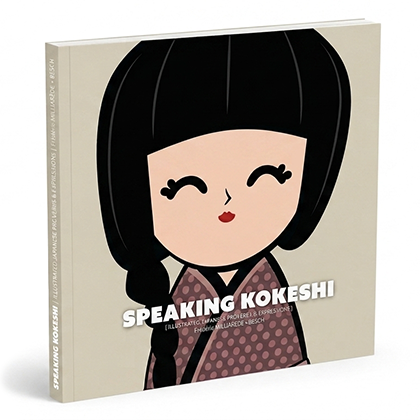
"Speaking Kokeshi" is a cultural project that combines visual elements of Japan 日本,
between kokeshi dolls こけし and proverbs (kotowaza) 諺, idioms, sayings, and lifestyle.
It is a collection of illustrated Japanese proverbs.
The collection started in May 2023.
New Kokeshi are published regularly.
The visuals are individually drawn.
The translation and explanation stem from research conducted to create the illustrations.
#024
The best gift is a waste on the wrong person. 猫に小判
猫に小判 « Neko ni koban »
Literal: To give a golden coin to a cat.
Meaning: A reminder that offering value, whether it be wisdom, advice, or opportunity, to someone incapable of appreciating it is a futile waste of effort.
The proverb is first cited in a Japanese text from 1687. In the later Edo period, it entered the 「 iroha karuta 」
(いろはかるた), a card-matching game used to teach children the hiragana syllabary.
The koban was one of the most recognizable objects of Edo-period (1603-1868), a coin valuable enough that most ordinary people rarely had occasion to handle one. The cat doesn’t eat the koban. It doesn’t bat it around. It barely registers it. Not out of stupidity, but because it lives in a world where gold simply doesn’t compute.
This is where Confucian thinking becomes relevant. Proper alignment mattered, the right knowledge to the right student, the right role to the right person, the right gift to the right recipient. Value is relational.
Gold is only gold to someone who understands what gold means.
In contemporary Japan, it surfaces wherever genuine effort meets genuine unavailability. In 「 monozukuri 」
(物作り the culture of skilled making), it describes the frustration of a transmission that found no receiver: the apprentice who was present without being ready, the student who attended without yet having the preparation to absorb what was in front of them. The timing, the match, or the readiness was simply wrong. The phrase has grown a little warmer nowadays, less a pronouncement than a private acknowledgment of the limits of goodwill.
There’s a layer Western readers tend to miss. In Japan, 「 neko 」 (猫 the cat ) has always occupied an ambiguous, aesthetically charged place. Beloved, associated with good fortune, but also with a kind of self-possessed indifference to human priorities. The cat is not a symbol of foolishness. It’s a symbol of different concerns entirely. The proverb doesn’t condemn the cat. It observes, without rancor, that the encounter was structurally impossible from the start, and that distinction matters: there is no villain here, only a mismatch.
Note: The 「 maneki-neko 」 (招き猫, the beckoning cat), Japan’s talisman of commercial fortune, now typically holds a koban in its paw. Supposedly, the earliest ceramic maneki-neko, documented in Utagawa Hiroshige’s 1852 ukiyo-e print, wore only a bell around the neck. The coin came later, as Japan’s commercial culture deepened. A cat paired with a gold coin was initially not a symbol of luck. That the two eventually merged, the lucky cat grasping what the proverb’s cat cannot value, is not quite irony, but it is very close.
Speaking Kokeshi#024 — The best gift is a waste on the wrong person. — 猫に小判
Speaking Kokeshi started in May 2023 from a simple observation: Japan has one of the richest traditions of proverbial expression in the world, and most of it is either unknown outside the country or reduced to a handful of pop concepts stripped of their context.
The original idea was to adapt the tradition of 19th-century European talking plates to modern times — objects that carried a phrase, a face, a moral. The kokeshi doll was the right vehicle. Spare, distinctive, rooted in Japanese craft, it allows the illustration to carry meaning without excess.
Forty proverbs. Forty characters. Each drawn individually, each the result of research into the cultural and historical origins of the expression. Not a catalog. A book with a point of view.