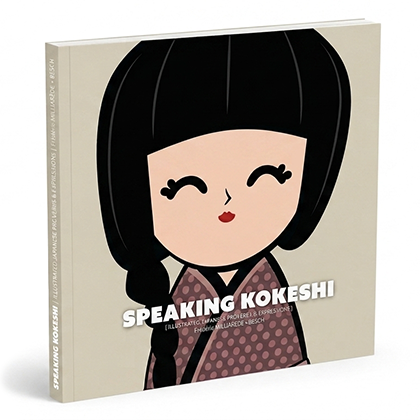
"Speaking Kokeshi" is a cultural project that combines visual elements of Japan 日本,
between kokeshi dolls こけし and proverbs (kotowaza) 諺, idioms, sayings, and lifestyle.
It is a collection of illustrated Japanese proverbs.
The collection started in May 2023.
New Kokeshi are published regularly.
The visuals are individually drawn.
The translation and explanation stem from research conducted to create the illustrations.
Literal: The ground becomes firm after rain.
Meaning: Trouble, once weathered, leaves things stronger than before.
Rain doesn’t destroy the ground. It loosens it, turns it soft and uncertain for a while, and then, as it drains away and the air dries out, leaves it harder than before. Japanese farmers understood this long before it became a proverb. The image is almost mundane. But the logic inside it is precise. Soil that has never been disturbed stays loose and easily scattered. Soil that has been soaked and dried develops structure. The hardship isn’t incidental to the result. It’s what produces it.
The proverb most likely consolidated during the Edo period (1603–1868), when agrarian observations were being gathered and refined into the compact verbal forms known as 「 kotowaza 」 (諺 proverbs). The philosophical temperament that emerged from this combination was neither sentimental about hardship nor dismissive of it. Trouble passes, and what remains is the more solid for having endured the pressure.
In Japan today, it surfaces often in professional settings. After a tense project, a failed launch, or a conflict between teams that has been resolved, it works as a reframe. What looked like damage is recast as consolidation. It shows up in management writing, in coaching contexts, and in the kind of quiet remark a senior colleague makes to a younger one who has just come through something hard.
What sets this saying apart from its Western counterparts is a question of where the transformation happens. Nietzsche’s aphorism in Götzen-Dämmerung (1889) “ That which does not kill me makes me stronger. ” places the change inside the individual. You survive, you are altered, you emerge stronger. The French “ après la pluie, le beau temps ” (after the rain comes the good weather) is about emotional recovery, the return of warmth.
This proverb is about something more structural: not that you feel better, or that you have grown personally, but that the situation itself, the relationship, the social bond, is now more solid than before the difficulty.
That distinction matters. The proverb carries a collective weight that the Western versions tend not to have. It does not celebrate personal resilience. It observes that tested ground holds.
Note: Igeta pattern. It depicts a water well being a source of water, it represents good fortune and life.
Speaking Kokeshi#031 — Strained bonds hold tighter. — 雨降って地固まる
Speaking Kokeshi started in May 2023 from a simple observation: Japan has one of the richest traditions of proverbial expression in the world, and most of it is either unknown outside the country or reduced to a handful of pop concepts stripped of their context.
The original idea was to adapt the tradition of 19th-century European talking plates to modern times — objects that carried a phrase, a face, a moral. The kokeshi doll was the right vehicle. Spare, distinctive, rooted in Japanese craft, it allows the illustration to carry meaning without excess.
Forty proverbs. Forty characters. Each drawn individually, each the result of research into the cultural and historical origins of the expression. Not a catalog. A book with a point of view.