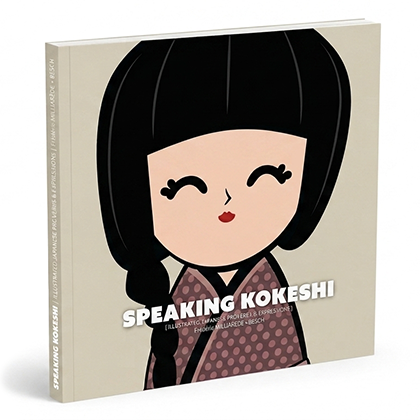
"Speaking Kokeshi" is a cultural project that combines visual elements of Japan 日本,
between kokeshi dolls こけし and proverbs (kotowaza) 諺, idioms, sayings, and lifestyle.
It is a collection of illustrated Japanese proverbs.
The collection started in May 2023.
New Kokeshi are published regularly.
The visuals are individually drawn.
The translation and explanation stem from research conducted to create the illustrations.
Literal: A man who hunts two hares, does not deserve one.
Meaning: Trying to do two things at once and risking failure in both.
The image is almost uncomfortably precise. Two hares, two directions, and the hunter comes home empty-handed. What makes this one unusual in the Japanese collection is that its precision is borrowed. Most Japanese speakers today use it with no sense of where it came from.
The ancestral form is Latin, attributed to Publilius Syrus: “ Duos insequens lepores, neutrum capit ”. Erasmus collected it in his Adagia in the early sixteenth century, and from there it traveled across European languages for three centuries. It reached Japan not through a single door but through several at once, Dutch, French, and English versions all arriving around the final years of the Edo period. The 「 Seiyō Kotowaza Kusa 」 (西洋諺草 Grasses of Western Proverbs), published in 1877, introduced it formally to Japanese readers.
Japan already had its own caution against divided effort: 「 abu hachi torazu 」 (虻蜂取らず catching neither the horsefly nor the bee) covers the same ground. But the imported version, cleaner in its image and carrying the quiet authority of centuries of European use, gradually displaced the native equivalent.
The Confucian current running through Meiji education gave it a moral edge beyond professional advice.
「 Shūchū 」 (集中 concentration) was read as integrity. To scatter your attention was to disrespect your work, your teacher, your craft.
Today it shows up in management coaching and advice columns for young workers weighing multiple side projects (「 fukugyō 」, 副業 secondary work). The tone has softened, where the original read divided ambition as foolishness, current usage tends to frame the same warning as a kindness toward yourself.
Western readers will recognize this one more directly than they expect, because they have been living with the same sentence, in different clothes, for five centuries. What it means for the supposed universality of this wisdom that it traveled from Rome to Rotterdam to Tokyo via a school textbook is a question the proverb quietly raises about itself.
Speaking Kokeshi#003 — Running after two hares. — 二兎を追う者は一兎をも得ず
Speaking Kokeshi started in May 2023 from a simple observation: Japan has one of the richest traditions of proverbial expression in the world, and most of it is either unknown outside the country or reduced to a handful of pop concepts stripped of their context.
The original idea was to adapt the tradition of 19th-century European talking plates to modern times — objects that carried a phrase, a face, a moral. The kokeshi doll was the right vehicle. Spare, distinctive, rooted in Japanese craft, it allows the illustration to carry meaning without excess.
Forty proverbs. Forty characters. Each drawn individually, each the result of research into the cultural and historical origins of the expression. Not a catalog. A book with a point of view.