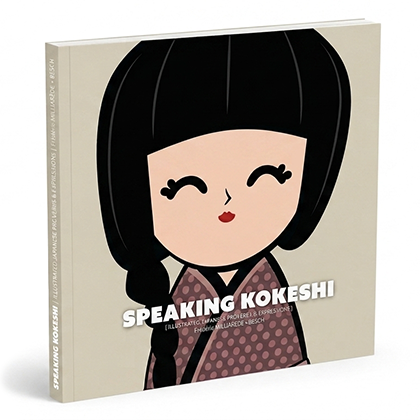
"Speaking Kokeshi" is a cultural project that combines visual elements of Japan 日本,
between kokeshi dolls こけし and proverbs (kotowaza) 諺, idioms, sayings, and lifestyle.
It is a collection of illustrated Japanese proverbs.
The collection started in May 2023.
New Kokeshi are published regularly.
The visuals are individually drawn.
The translation and explanation stem from research conducted to create the illustrations.
#022
A stroke of luck that is almost too perfect. 鴨がねぎ背負って来る
鴨がねぎ背負って来る « Kamo ga negi wo shotte kuru »
Literal: A duck arrives carrying a green onion (scallion) on its back.
Meaning: Something perfectly convenient or advantageous falls right into your lap by pure chance.
The image works because it is genuinely funny, and the Japanese have never been embarrassed by that. A duck appears at your door. It has brought the green onion. In Japanese cooking, 「 kamo 」 (鴨 duck) and 「 negi 」 (ねぎ green onion) have belonged together for centuries, most visibly in 「 kamo nanban 」 (鴨南蛮, duck and scallion soba). The duck does not know it is dinner. The scallion does not know it is garnish. And yet here they both are.
The proverb almost certainly belongs to Edo-period popular culture, which fits: that era had a particular taste for humor that was earthy, visual and faintly dark. The urban commoners of Edo, 「 chōnin 」 (町人 townspeople), found their philosophy in the market and the kitchen, not the monastery, and were perfectly willing to locate the human condition in a duck carrying its own garnish.
There is a second layer here that makes the phrase sharper than a simple expression of good luck. In Japanese,
「 kamo 」 is also slang for a naive person, a mark. The duck in this proverb is thus the unexpected windfall and the oblivious agent of its own undoing at once, which means the speaker occupies, subtly, the predator’s position. This is less about fortune smiling than about a clear-eyed recognition of how perfectly things have aligned. The luck is real. The perspective is sharp.
Contemporary Japanese uses the expression with that edge intact. In business, it describes the competitor who stumbles into your territory already weakened, or the client who arrives having already decided to buy. In everyday life, it fits the moment when someone who owes you a favor calls precisely when you need one. The register is always slightly gleeful, the pleasure of it coming partly from the acknowledgment that you did nothing to engineer this, but you will absolutely benefit from it.
English has “ sitting duck ” and “ pigeon ”, but those describe the victim’s situation, not the onlooker’s delight. French has “ c’est le jackpot ” which captures the windfall but misses the specific comedy of the duck’s unwitting collaboration. What this proverb names is the view from the other side: the moment you see the duck arriving, notice the scallion, and understand that dinner has arranged itself.
Speaking Kokeshi#022 — A stroke of luck that is almost too perfect. — 鴨がねぎ背負って来る
Speaking Kokeshi started in May 2023 from a simple observation: Japan has one of the richest traditions of proverbial expression in the world, and most of it is either unknown outside the country or reduced to a handful of pop concepts stripped of their context.
The original idea was to adapt the tradition of 19th-century European talking plates to modern times — objects that carried a phrase, a face, a moral. The kokeshi doll was the right vehicle. Spare, distinctive, rooted in Japanese craft, it allows the illustration to carry meaning without excess.
Forty proverbs. Forty characters. Each drawn individually, each the result of research into the cultural and historical origins of the expression. Not a catalog. A book with a point of view.