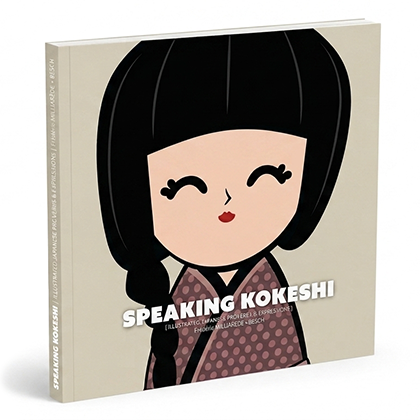
"Speaking Kokeshi" is a cultural project that combines visual elements of Japan 日本,
between kokeshi dolls こけし and proverbs (kotowaza) 諺, idioms, sayings, and lifestyle.
It is a collection of illustrated Japanese proverbs.
The collection started in May 2023.
New Kokeshi are published regularly.
The visuals are individually drawn.
The translation and explanation stem from research conducted to create the illustrations.
Literal: One lifetime, one encounter.
Meaning: Every encounter is a once-in-a-lifetime moment.
In 1858, Ii Naosuke, a statesman and tea master whose career would end with his assassination two years later, compiled a short treatise now called 「 chadō ichie ki 」 (茶湯一会集 The Record of One Meeting in Tea). In it, he described the spirit that should govern every gathering: host and guest must each understand that an occasion like this one will never come again in their lifetimes. Its deeper roots are traced by later sources to Sen no Rikyū (千利休), the sixteenth-century master who shaped 「 chadō 」 (茶道 the way of tea) into the form it still holds today. What Rikyū understood, and Ii Naosuke put into words, is that every detail of a tea gathering converges once: the season, the light entering the room, the mood of those present, the particular bowl chosen for that morning. None of it will reassemble the same way.
The Buddhist concept of 「 mujō 」 (無常 impermanence) is the philosophical ground beneath ichigo ichie: moments do not accumulate, they dissolve. What makes an encounter precious is inseparable from its fragility.
In contemporary Japan, the phrase travels well beyond the tea room. At weddings and farewell parties, at the close of a school year, before a difficult medical procedure. It surfaces wherever people sense something irreversible is happening. After the earthquake and tsunami of 2011, it circulated widely, not quite as consolation, but as a recognition that ordinary life is full of unrepeatable encounters most of us fail to register until they are gone. It appears in corporate hospitality training, in frameworks built around 「 omotenashi 」 (おもてなし wholehearted service), and in wedding speeches.
Western readers will reach almost automatically for “ carpe diem ”, and the resonance is real but imprecise. Horace’s injunction is to seize, to act before time runs out; it carries the urgency of mortality pressing on the individual. 「 Ichigo 」 ichie is less an imperative than a quality of attention. It does not ask you to do anything with the moment. It asks you to receive it, and to understand that the person in front of you, in this specific configuration of circumstance, will only ever appear once in this form. The relational dimension is what Western equivalents consistently miss. Mindfulness traditions have rediscovered present-moment awareness, but frame it as a solitary practice. Ichigo ichie is structurally about encounter. It cannot be practiced alone.
Speaking Kokeshi#028 — One shared moment in time. — 一期一会
Speaking Kokeshi started in May 2023 from a simple observation: Japan has one of the richest traditions of proverbial expression in the world, and most of it is either unknown outside the country or reduced to a handful of pop concepts stripped of their context.
The original idea was to adapt the tradition of 19th-century European talking plates to modern times — objects that carried a phrase, a face, a moral. The kokeshi doll was the right vehicle. Spare, distinctive, rooted in Japanese craft, it allows the illustration to carry meaning without excess.
Forty proverbs. Forty characters. Each drawn individually, each the result of research into the cultural and historical origins of the expression. Not a catalog. A book with a point of view.