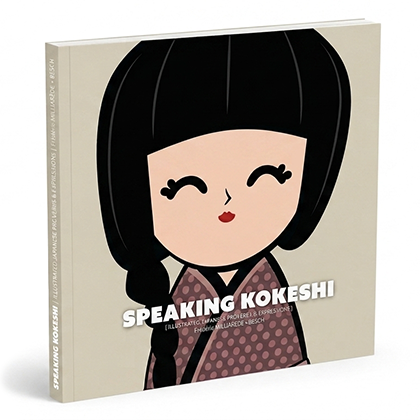
"Speaking Kokeshi" is a cultural project that combines visual elements of Japan 日本,
between kokeshi dolls こけし and proverbs (kotowaza) 諺, idioms, sayings, and lifestyle.
It is a collection of illustrated Japanese proverbs.
The collection started in May 2023.
New Kokeshi are published regularly.
The visuals are individually drawn.
The translation and explanation stem from research conducted to create the illustrations.
Literal: The blind evaluating the elephant.
Meaning: Each person grasps one piece of the whole and mistakes it for the complete picture, a collective blindness that even careful, well-intentioned observation cannot prevent.
The image behind this proverb is old enough to have crossed several civilizations before reaching Japan. Its earliest known appearances are in ancient Indian texts. It surfaces in the Udāna (1st century BCE), a collection of sayings attributed to the Buddha, as a pointed comment on religious disputation: each teacher grabs a piece of the truth and argues as though he holds the whole. The image traveled the Silk Road through China, eventually arriving in Japan with the broader wave of Buddhist thought during the Nara period (710–794 CE).
By the time it settled into Japanese, something had quietly shifted. The Japanese formulation insists on the plural 「 gunmō 」 means “ a multitude of blind people ”. The proverb isn’t about one person making an error. It’s about what happens when many partial views are each mistaken, collectively, for a complete picture.
That distinction matters philosophically. Buddhist epistemology had long wrestled with the problem of 「 māyā 」 (幻 illusion), the idea that perception builds a version of reality shaped more by our limitations than by what’s actually there. The blind men in the parable aren’t being careless. They touch, they reason, they conclude. The error is the assumption that one fragment is enough
In contemporary Japan, the proverb turns up in professional settings where specialization has made real synthesis structurally difficult. The engineer, the salesperson, the designer: each competent, each right within their domain, and yet the organization can still fail to understand what it’s actually building.
What the proverb adds beyond a lesson in humility is a harder question: does gathering more perspectives help? In the original parable, the blind men don’t suddenly understand the elephant by comparing notes. More viewpoints don’t automatically produce better knowledge. What shifts is the awareness that the picture is incomplete, and in the Buddhist reading, that awareness already counts as a kind of wisdom.
Note: Tatewaku Pattern. These vertical waves evoke mist and steam rising towards the sky, particularly in spring. They symbolize the ability to rise above life’s events. This pattern, dating back to the Middle Ages, was considered a remarkable technical feat at the time.
Speaking Kokeshi#038 — Wisdom in awareness of the unknown. — 群盲象を評す
Speaking Kokeshi started in May 2023 from a simple observation: Japan has one of the richest traditions of proverbial expression in the world, and most of it is either unknown outside the country or reduced to a handful of pop concepts stripped of their context.
The original idea was to adapt the tradition of 19th-century European talking plates to modern times — objects that carried a phrase, a face, a moral. The kokeshi doll was the right vehicle. Spare, distinctive, rooted in Japanese craft, it allows the illustration to carry meaning without excess.
Forty proverbs. Forty characters. Each drawn individually, each the result of research into the cultural and historical origins of the expression. Not a catalog. A book with a point of view.