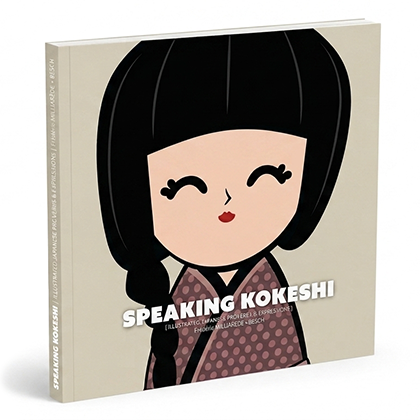
"Speaking Kokeshi" is a cultural project that combines visual elements of Japan 日本,
between kokeshi dolls こけし and proverbs (kotowaza) 諺, idioms, sayings, and lifestyle.
It is a collection of illustrated Japanese proverbs.
The collection started in May 2023.
New Kokeshi are published regularly.
The visuals are individually drawn.
The translation and explanation stem from research conducted to create the illustrations.
狐が下手の射る矢を恐る « kitsune ga heta no iru ya wo osoru »
Literal: A fox is afraid of a poorly shot arrow.
Meaning: Even the cleverest adversary is powerless against an amateur’s unpredictability.
There is a kind of danger that cleverness simply cannot handle. In Japanese folklore, the 「 kitsune 」 (狐, fox) is the ultimate trickster: the shape-shifter who reads human intentions, slips through traps, and generally outsmarts everyone in the room. Centuries of stories, paintings, and shrine mythology treat the fox as a creature of near-supernatural intelligence. So when this proverb tells us the fox is afraid, it’s worth asking: afraid of what exactly?
Not the skilled archer. A seasoned bowman’s posture can be read, his shot anticipated, his arrow dodged with a fraction of a second to spare. What stops the fox cold is the arrow from someone who barely knows how to hold a bow. That arrow could go anywhere. Cunning is useless against randomness.
The proverb most likely dates to the Edo period (1603-1868), when the samurai class had codified combat into formalized disciplines like 「 kyūjutsu 」 (弓術 archery) or 「 bushidō 」 (武士道 the way of the warrior). Mastery wasn’t just a technical achievement; it was a moral one. A trained warrior was predictable in the best sense. His actions legible even under pressure, his behavior governed by a code. The untrained person operated outside any such framework. Competence was inseparable from character. To have submitted to a discipline was to be trustworthy. Those who had not were unpredictable in a deeper sense than the merely technical.
In contemporary Japan, the proverb finds a natural home in professional settings. Company culture (「 kaisha bunka 」, 会社文化) places a high premium on training and rehearsed procedure, precisely because collective work depends on legible behavior. A new employee who improvises rather than follows established protocols creates a specific kind of anxiety. Not that they’ll fail, but that no one can predict how.
The English “ loose cannon ” gestures in this direction, though it emphasizes danger over unpredictability. What the Japanese proverb captures more precisely is the experience of the observer. The fox is intelligent enough to know exactly what it cannot prepare for. That is an unsettling thought, and it crosses cultures cleanly.
Note. Yabane pattern. It represents feathers used in arrows. The design is symbolic of aiming for a target, as arrows do not return once shot. Brides used to wear kimonos featuring this pattern as a symbol of good luck, to prevent the need for them to return to their family.
Speaking Kokeshi#032 — Beware the unreadable move. — 狐が下手の射る矢を恐る
Speaking Kokeshi started in May 2023 from a simple observation: Japan has one of the richest traditions of proverbial expression in the world, and most of it is either unknown outside the country or reduced to a handful of pop concepts stripped of their context.
The original idea was to adapt the tradition of 19th-century European talking plates to modern times — objects that carried a phrase, a face, a moral. The kokeshi doll was the right vehicle. Spare, distinctive, rooted in Japanese craft, it allows the illustration to carry meaning without excess.
Forty proverbs. Forty characters. Each drawn individually, each the result of research into the cultural and historical origins of the expression. Not a catalog. A book with a point of view.