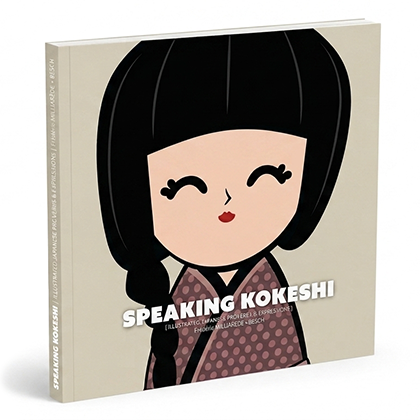
"Speaking Kokeshi" is a cultural project that combines visual elements of Japan 日本,
between kokeshi dolls こけし and proverbs (kotowaza) 諺, idioms, sayings, and lifestyle.
It is a collection of illustrated Japanese proverbs.
The collection started in May 2023.
New Kokeshi are published regularly.
The visuals are individually drawn.
The translation and explanation stem from research conducted to create the illustrations.
Literal: Getting up early is a virtue worth three mon.
Meaning: Rising early brings modest but real rewards, and learning to count small gains is a virtue in itself.
Three 「 mon 」(文). In Edo-period Japan, that was roughly the cost of a small serving of tofu from a street vendor, one of the smallest coins you could carry. And that’s exactly what it promises to the person who gets up before dawn: not success, not a head start, just three copper coins. The understatement is the whole point.
The proverb grew out of the moral culture of the Edo period (1603-1868), when 「 chōnin 」 (町人 merchant townspeople) were developing their own practical ethics alongside the samurai codes. Confucian thought ran deep in that world, and it valued daily discipline (「 shugyō 」 修行, sustained, repetitive practice) not as a means to an end but as the process by which character is built. Getting up early wasn’t a productivity strategy. It was a quiet, dailyact of becoming the kind of person who gets up early.
The idea has Chinese roots that are genuinely hard to trace. Various classical Chinese sayings link early rising to virtue and extra accomplishment, and the Japanese proverb likely absorbed this influence through centuries of 「 kanbun 」 (漢文 classical Chinese writing) that shaped Japanese intellectual life.What Japan did with it was pare it back: less triumphant, more matter-of-fact.
Today, the proverb lives in two registers at once. Parents use it with children as a gentle nudge, almost a lullaby for good habits. It also echoes through 「 asa katsu 」 (朝活, morning activities), a real cultural movement that emerged in Japanese cities from the mid-2000s onward, with early study groups, pre-commute yoga, and breakfast networking circles. There’s a soft irony in the background, though: in a country where late nights at the office or the 「 izakaya 」 (居酒屋 informal bar-restaurant) are perfectly ordinary, the early riser remains more ideal than norm.
Most productivity culture argues upward: wake early, accomplish more, optimize your edge. This proverb doesn’t bother. Three 「 mon 」is three 「 mon 」, and no one is pretending otherwise. The value isn’t the reward, it’s the noticing of it. That’s closer to Aristotle than to any bestseller: the early riser isn’t extracting something from the morning. They’re becoming someone for whom mornings mean something.
Speaking Kokeshi#035 — The virtue of first light. — 早起きは三文の徳
Speaking Kokeshi started in May 2023 from a simple observation: Japan has one of the richest traditions of proverbial expression in the world, and most of it is either unknown outside the country or reduced to a handful of pop concepts stripped of their context.
The original idea was to adapt the tradition of 19th-century European talking plates to modern times — objects that carried a phrase, a face, a moral. The kokeshi doll was the right vehicle. Spare, distinctive, rooted in Japanese craft, it allows the illustration to carry meaning without excess.
Forty proverbs. Forty characters. Each drawn individually, each the result of research into the cultural and historical origins of the expression. Not a catalog. A book with a point of view.