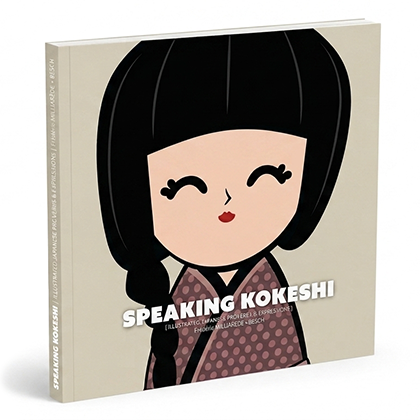
"Speaking Kokeshi" is a cultural project that combines visual elements of Japan 日本,
between kokeshi dolls こけし and proverbs (kotowaza) 諺, idioms, sayings, and lifestyle.
It is a collection of illustrated Japanese proverbs.
The collection started in May 2023.
New Kokeshi are published regularly.
The visuals are individually drawn.
The translation and explanation stem from research conducted to create the illustrations.
Literal: A fish that has obtained water.
Meaning: Acting with maximum vitality and efficiency because one’s specific talents have finally met their ideal conditions.
The image is simple enough to need no translation: a fish returned to water. But what makes it more than a pleasant metaphor is the claim it makes about talent itself. This is a proverb that quietly refuses the idea that skill is purely portable, that a gifted person will flourish anywhere they go. It says something more precise, and more honest: vitality is relational. It depends on the fit between a being and its world.
The expression actually traces back to Chinese classical literature, specifically the 「Sangokushi」 (三国志 the Records of the Three Kingdoms, 3rd century CE), where a similar phrase described the bond between the strategist Zhuge Liang and the warlord Liu Bei. Two men whose abilities completed each other so exactly that neither could be fully himself without the other. The image passed into Japanese through the 「kanbun」 (漢文) tradition of reading Chinese classical texts, and settled in during the Edo period, when 「Shushigaku」 (朱子学 Neo-Confucian thought) shaped how Japanese society understood the relationship between a person and their role. The idea being where you are placed matters as much as what you are.
In contemporary Japan, the phrase comes up most naturally in sports commentary and office culture. A footballer who joins a new club and suddenly becomes decisive. An engineer reassigned to a team where their particular obsessions are actually useful. These are the fish that have found their water. The proverb echoes 「ikigai」, one’s reason for being (#039), though the two are distinct. 「Ikigai」 is about purpose, this one is about conditions.
Western readers will recognize the image immediately: “ like a fish in water ”. What stands out in the Japanese interpretation is that the fish doesn’t just become more comfortable, it becomes something it could not have been otherwise.
Note: Seigaiha (Blue Ocean Waves) pattern. The waves of the sea, calm and quiet, but also powerful and resilient as they keep crashing incessantly on the shore. It’s also a symbol of rising good luck.
Speaking Kokeshi#016 — Like a fish in the water. — 水を得た魚
Speaking Kokeshi started in May 2023 from a simple observation: Japan has one of the richest traditions of proverbial expression in the world, and most of it is either unknown outside the country or reduced to a handful of pop concepts stripped of their context.
The original idea was to adapt the tradition of 19th-century European talking plates to modern times — objects that carried a phrase, a face, a moral. The kokeshi doll was the right vehicle. Spare, distinctive, rooted in Japanese craft, it allows the illustration to carry meaning without excess.
Forty proverbs. Forty characters. Each drawn individually, each the result of research into the cultural and historical origins of the expression. Not a catalog. A book with a point of view.