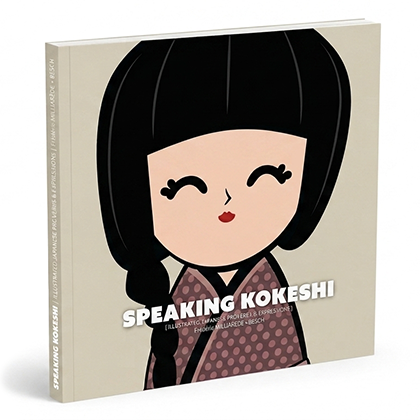
"Speaking Kokeshi" is a cultural project that combines visual elements of Japan 日本,
between kokeshi dolls こけし and proverbs (kotowaza) 諺, idioms, sayings, and lifestyle.
It is a collection of illustrated Japanese proverbs.
The collection started in May 2023.
New Kokeshi are published regularly.
The visuals are individually drawn.
The translation and explanation stem from research conducted to create the illustrations.
#010
Feigning ignorance or sleep to dodge trouble. 狸寝入り
狸寝入り « Tanuki Neiri »
Literal: The sleep of the tanuki.
Meaning: To avoid an unpleasant situation.
The 「 tanuki 」 (狸 Japanese raccoon dog) has been a fixture of Japanese folklore for over a thousand years, and its reputation has always been complicated. It shapeshifts, it deceives, it turns leaves into money and stones into sake. When startled or caught off guard, they may play dead or feign sleep as a defense mechanism. By pretending to be asleep, they might attempt to deceive their observers into thinking they are harmless or unaware, allowing them an opportunity to escape when the moment is right.
But unlike the 「 kitsune 」 (狐 fox), whose trickery tends toward the predatory, the tanuki is fundamentally a survivor. Its cleverness is defensive. It doesn’t scheme to take something from you but to get away from you.
The feigned sleep at the heart of the image isn’t aggression or cunning in the ambitious sense. It’s a way out. You pretend not to hear, not to see, not to be quite present enough to be held responsible. The uncomfortable conversation continues around you. The difficult decision lands on someone else. And when the moment is right, you slip away.
The behavior the proverb describes has deep roots in a culture where direct confrontation carries real social cost. Confucian frameworks of hierarchy and obligation, which shaped Japanese social life through the Edo period (1603-1868) and well beyond, made certain refusals genuinely difficult to voice. Feigned sleep, literal or figurative, offered a way to avoid without refusing, to absent yourself without the rupture of a direct no. Whether that makes it wisdom or evasion probably depends on who’s waiting for an answer.
In Japan today, the phrase gets used with a certain wry affection. A colleague who somehow misses every difficult meeting, a family member who goes suspiciously quiet when responsibilities are being divided. It names what everyone has noticed but nobody wants to say outright. It’s an accusation soft enough to land as a joke.
Western readers will recognize the impulse immediately. “ Playing possum ” covers the literal image. But 「 tanuki neiri 」 carries something the English phrase doesn’t: the cultural memory of an animal whose survival has always depended on being underestimated. The tanuki isn’t hiding because it’s weak. It’s hiding because it’s patient.
Speaking Kokeshi#010 — Feigning ignorance or sleep to dodge trouble. — 狸寝入り
Speaking Kokeshi started in May 2023 from a simple observation: Japan has one of the richest traditions of proverbial expression in the world, and most of it is either unknown outside the country or reduced to a handful of pop concepts stripped of their context.
The original idea was to adapt the tradition of 19th-century European talking plates to modern times — objects that carried a phrase, a face, a moral. The kokeshi doll was the right vehicle. Spare, distinctive, rooted in Japanese craft, it allows the illustration to carry meaning without excess.
Forty proverbs. Forty characters. Each drawn individually, each the result of research into the cultural and historical origins of the expression. Not a catalog. A book with a point of view.