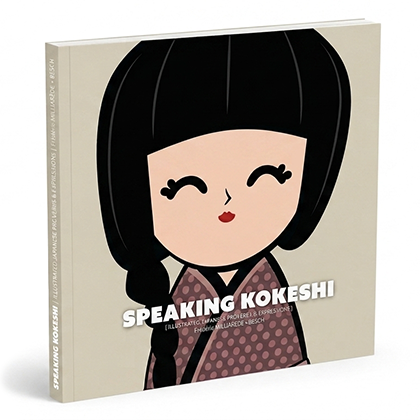
"Speaking Kokeshi" is a cultural project that combines visual elements of Japan 日本,
between kokeshi dolls こけし and proverbs (kotowaza) 諺, idioms, sayings, and lifestyle.
It is a collection of illustrated Japanese proverbs.
The collection started in May 2023.
New Kokeshi are published regularly.
The visuals are individually drawn.
The translation and explanation stem from research conducted to create the illustrations.
#027
Competence is a currency that never loses its value. 芸は身を助く
芸は身を助く « gei wa mi wo tasuku »
Literal: A craft saves the self.
Meaning: Mastery is the ultimate survival kit.
The proverb most likely took shape during the Edo period (1603-1868), when a rigid social hierarchy governed who could own property, move between provinces, or aspire to anything beyond their station. Inside those constraints, performers, musicians, and artisans who had mastered a 「 gei 」 (芸 art, craft, performing skill) occupied a peculiar position: officially marginal, practically indispensable. Without land to fall back on, hereditary rank, family name worth invoking, they knew the skill they carry cannot be confiscated, taxed, or burned.
In Confucian thought, mastery was a form of moral cultivation, the discipline required to achieve it considered virtuous in itself, the transmission between teacher and student almost sacred. A craft was a path in the fullest sense: 「 gei 」 shares its gravitational field with 「 dō 」 (道 the Way), the suffix running through 「 kendō 」 (剣道 way of the sword), 「 sadō 」 (茶道 way of tea), 「 shodō 」 (書道 way of calligraphy).
Saving yourself through craft meant becoming, not just surviving.
In contemporary Japan the proverb keeps surfacing, in career counseling, in conversations about freelancing and side income, in the vocabulary of professionals navigating restructuring or early retirement. Japan’s long stagnation since the 1990s has worn away the postwar promise of lifetime employment that once defined the salaryman. Against that erosion, it functions as both consolation and practical instruction: your title will not travel with you, your expertise will. There is something almost Buddhist in this framing of security as internal rather than institutional, impermanence accepted rather than fought.
What resists translation is its layered quality. «Ars longa, vita brevis» points to art’s longevity against the brevity of life. The English “ a trade in your hands is a fortune in your pocket ” is blunter and entirely mercantile. This proverb is about what skill and identity actually mean to each other. What you know how to do is not simply an asset. It is, in the deepest sense, who you are when everything else has been stripped away.
Note: Kagome pattern. A lattice-like pattern that comes from the art of weaving baskets. 「 Kago 」 means a basket, while 「 Me 」 means eye. These two words combined means a pattern of holes. It is viewed as a protective pattern, like a fence against devils and misfortune.
Speaking Kokeshi#027 — Competence is a currency that never loses its value. — 芸は身を助く
Speaking Kokeshi started in May 2023 from a simple observation: Japan has one of the richest traditions of proverbial expression in the world, and most of it is either unknown outside the country or reduced to a handful of pop concepts stripped of their context.
The original idea was to adapt the tradition of 19th-century European talking plates to modern times — objects that carried a phrase, a face, a moral. The kokeshi doll was the right vehicle. Spare, distinctive, rooted in Japanese craft, it allows the illustration to carry meaning without excess.
Forty proverbs. Forty characters. Each drawn individually, each the result of research into the cultural and historical origins of the expression. Not a catalog. A book with a point of view.