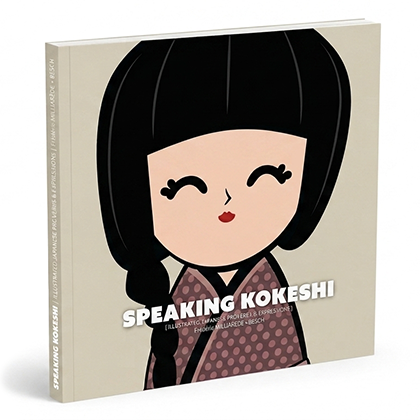
"Speaking Kokeshi" is a cultural project that combines visual elements of Japan 日本,
between kokeshi dolls こけし and proverbs (kotowaza) 諺, idioms, sayings, and lifestyle.
It is a collection of illustrated Japanese proverbs.
The collection started in May 2023.
New Kokeshi are published regularly.
The visuals are individually drawn.
The translation and explanation stem from research conducted to create the illustrations.
Literal: Being bitten on the hand by a dog one has raised.
Meaning: Betrayed by someone one has trusted and nurtured.
A dog, the creature that chose humans over the wild, that guards the gate and sleeps at the foot of the bed, turning its teeth on the hand that held the bowl. In Japan, where canine loyalty has been elevated into cultural myth (Hachiko, who kept vigil at Shibuya station for nine years after his owner’s death, is still the country’s most iconic emblem of faithfulness), this proverb carries a weight that goes well beyond ordinary treachery. It names something precise, the betrayal that travels upward through a hierarchy, from someone who owes their standing to the very person they wound.
That upward direction matters. Shaped for centuries by Confucian ideas of 「 giri 」 (義理 duty and obligation) and 「 chūgi 」 (忠義 loyalty to one’s lord), Japanese society built itself around vertical bonds, each carrying obligations that were understood rather than negotiated. The 「 hōkōnin 」 (奉公人 retainer or servant) owed not just labor to the household that sheltered him, but allegiance. To break it was less a personal failing than a tear in the moral fabric holding communities together. The proverb most likely solidified during the Edo period (1603-1868), when Tokugawa governance formalized status hierarchies and made the duties between superior and subordinate both precise and consequential.
The image holds in contemporary Japan because the social terrain it describes has not changed as much as the surface suggests. The 「 senpai-kōhai 」 (先輩後輩 senior-junior) system still runs through most workplaces. The senior advocates, opens doors, and passes knowledge down; the junior defers and is expected to return that investment through loyalty over time. When that contract breaks (a junior taking credit for a superior’s work, or siding with management against the person who trained them). 「 Kaiinu ni te o kamareru 」 is the phrase that surfaces, naming the particular sting of misplaced trust in a way the blander word «betrayal» cannot.
For a Western reader, the precision is the point. The English “ bite the hand that feeds you ” applies to anyone, any beneficiary turning on any benefactor. This proverb is narrower and more cutting. It specifies the subordinate, the one brought in, cultivated, depended on. The wound in the English version lands between strangers or equals. This one is different, it comes from someone you shaped.
Speaking Kokeshi#036 — And you, Brutus? — 飼い犬に手を噛まれる
Speaking Kokeshi started in May 2023 from a simple observation: Japan has one of the richest traditions of proverbial expression in the world, and most of it is either unknown outside the country or reduced to a handful of pop concepts stripped of their context.
The original idea was to adapt the tradition of 19th-century European talking plates to modern times — objects that carried a phrase, a face, a moral. The kokeshi doll was the right vehicle. Spare, distinctive, rooted in Japanese craft, it allows the illustration to carry meaning without excess.
Forty proverbs. Forty characters. Each drawn individually, each the result of research into the cultural and historical origins of the expression. Not a catalog. A book with a point of view.