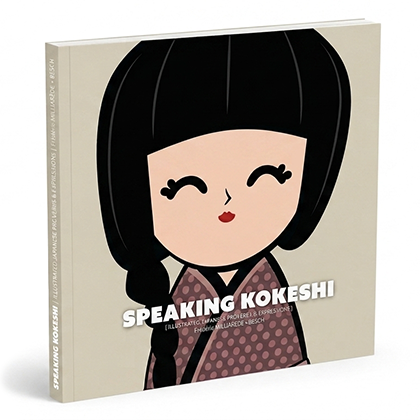
"Speaking Kokeshi" is a cultural project that combines visual elements of Japan 日本,
between kokeshi dolls こけし and proverbs (kotowaza) 諺, idioms, sayings, and lifestyle.
It is a collection of illustrated Japanese proverbs.
The collection started in May 2023.
New Kokeshi are published regularly.
The visuals are individually drawn.
The translation and explanation stem from research conducted to create the illustrations.
Literal: Seven times down, eight times up.
Meaning: Resilience through every fall.
The Daruma doll sits legless and round-bottomed for a reason. The figure comes from Bodhidharma, the Indian monk who brought Chan Buddhism to China in the 5th or 6th century and became the founding ancestor of Zen. Legend says he spent nine years meditating, completely still, facing a cave wall, until his limbs simply gave out. What the story encoded was that real depth requires a kind of stubborn, repeated return, getting back to the posture after every collapse. In Takasaki, during the Edo period, craftsmen turned that idea into a weighted toy that always rights itself when knocked over. The object and the proverb were made for each other.
The proverbe came out of the same cultural soil: Zen discipline, Confucian perseverance, and the practical stoicism demanded of ordinary people in a rigidly ordered society. The arithmetic deserves a second look. Seven falls, eight rises. The numbers are uneven on purpose. You get up one more time than you go down, and that asymmetry is everything. It says nothing about avoiding failure, nothing about dramatic comebacks. It says surplus, a quiet, stubborn excess of continuing. The Japanese values of 「 gaman 」 (我慢 patient endurance) and 「 nintai 」 (忍耐 perseverance) run close beneath it, both still embedded in how schools, sports teams, and workplaces talk about effort today.
In contemporary Japan the proverb travels widely, from exam prep campaigns to corporate slogans to post-game social media. Its register has shifted a little: what once described collective endurance is now more often cited as personal resilience, in step with the global language of self-development.
What tends to catch a Western reader off guard is not the idea, which has equivalents everywhere, but the tone. English offers “ if at first you don’t succeed, try, try again ”, a phrase that reads as instruction, almost impatient.
「 Nana korobi ya-oki 」 reads as plain observation, this is what life looks like when you keep going. Failure isn’t the obstacle to work around. It’s simply the condition under which getting back up becomes meaningful.
Note: Daruma come in different colors, predominantly red for luck. The slightly grayish white symbolizes balance, harmony, and purity.
The inscription 持久 「 jikyuu 」 means perseverance, endurance.
Speaking Kokeshi started in May 2023 from a simple observation: Japan has one of the richest traditions of proverbial expression in the world, and most of it is either unknown outside the country or reduced to a handful of pop concepts stripped of their context.
The original idea was to adapt the tradition of 19th-century European talking plates to modern times — objects that carried a phrase, a face, a moral. The kokeshi doll was the right vehicle. Spare, distinctive, rooted in Japanese craft, it allows the illustration to carry meaning without excess.
Forty proverbs. Forty characters. Each drawn individually, each the result of research into the cultural and historical origins of the expression. Not a catalog. A book with a point of view.