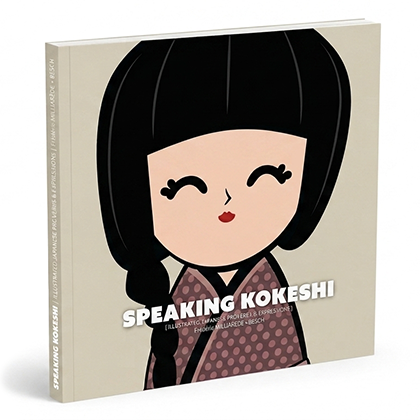
"Speaking Kokeshi" is a cultural project that combines visual elements of Japan 日本,
between kokeshi dolls こけし and proverbs (kotowaza) 諺, idioms, sayings, and lifestyle.
It is a collection of illustrated Japanese proverbs.
The collection started in May 2023.
New Kokeshi are published regularly.
The visuals are individually drawn.
The translation and explanation stem from research conducted to create the illustrations.
Literal: What the mind thinks, the heart transmits.
Meaning: The rare state where two people are so perfectly in sync that speech becomes unnecessary.
According to Zen Buddhist tradition, the Buddha once stood before his disciples and simply held up a flower (see #004). The whole gathering sat in silence, uncertain, except one disciple, Mahakasyapa, who responded with a quiet, knowing smile. In that exchange of flower and smile, something passed between two minds that no sermon could have carried. This moment is known in Japanese as 「 nenge mishō 」 (拈華微笑 the flower held, the subtle smile), and it became the founding image of transmission that moves entirely outside language.
「 I-shin den-shin 」 comes from Chinese Chan Buddhist thought and entered Japan through the monastic routes that carried Zen across the sea during the Kamakura period (1185–1333). Bodhidharma, the monk credited with founding Chan in China, gave the principle its most quoted form. A teaching described as 「 kyōge betsuden 」(教外別伝 transmission outside the scriptures, independent of written words) is the compressed, lived version of that idea. The belief that real understanding can move between people the way heat moves through stone, without visible mechanism, without announcement.
In traditional crafts, masters and apprentices still use it to describe the moment when years of proximity have trained the eye past what any instruction could reach. The apprentice acts rightly before being told, and both recognize the shift without naming it. Between long-time partners, it names the fluency of a relationship where sentences no longer need finishing (see #021). In professional settings, it gets invoked to describe teams that have truly found their rhythm, though it can also function as a quieter kind of pressure, the expectation that good people simply “ get it ” without being asked to explain themselves.
That second reading points to something the phrase holds that isn’t always easy. It describes a state that takes real time to reach: two people who have spent enough of themselves in the same current that words would only slow what already moves between them.
Western communication culture largely runs the other way, toward stating what you feel, asking for what you need, making the implicit explicit. There is value in that model. But this phrase maps something that model leaves mostly unnamed: not the failure of language, but what becomes possible once enough of it has passed.
Speaking Kokeshi started in May 2023 from a simple observation: Japan has one of the richest traditions of proverbial expression in the world, and most of it is either unknown outside the country or reduced to a handful of pop concepts stripped of their context.
The original idea was to adapt the tradition of 19th-century European talking plates to modern times — objects that carried a phrase, a face, a moral. The kokeshi doll was the right vehicle. Spare, distinctive, rooted in Japanese craft, it allows the illustration to carry meaning without excess.
Forty proverbs. Forty characters. Each drawn individually, each the result of research into the cultural and historical origins of the expression. Not a catalog. A book with a point of view.