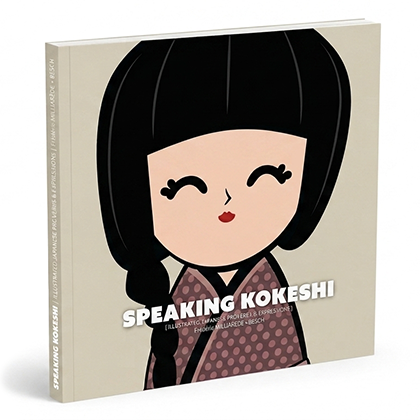
"Speaking Kokeshi" is a cultural project that combines visual elements of Japan 日本,
between kokeshi dolls こけし and proverbs (kotowaza) 諺, idioms, sayings, and lifestyle.
It is a collection of illustrated Japanese proverbs.
The collection started in May 2023.
New Kokeshi are published regularly.
The visuals are individually drawn.
The translation and explanation stem from research conducted to create the illustrations.
Literal: One or eight (also randomness or randomness).
Meaning: There is no middle ground, total success or total failure. It’s about the result.
During the Edo period, a class of itinerant gamblers known as 「 bakuto 」 (博徒) lived at the margins of a society built on rigid caste hierarchy. Their game of choice, 「 cho-han bakuchi 」 (丁半博打 even-odd dice game), came down to a single bet. Whether the sum of two dice would be 「 cho 」 (丁 even) or 「 han 」 (半 odd).
In the shorthand of the gambling den, each character was reduced to its most visible element:
丁 evoking 一 (「 ichi 」 one), 半 evoking 八 (「 hachi 」 eight, voiced to 「 bachi 」 by the Japanese phonological rule of 「 rendaku 」 (連濁 sequential voicing)), or so the most widely repeated etymology holds.
From that compression came a phrase that named not a number, but the quality of the instant before the dice settle, when every outcome is still alive and none can be steered. One or eight.
What makes 「 ichi ka bachi ka 」 worth examining is the journey it made afterward. It traveled from gambling dens into everyday Japanese speech without losing its original weight. When a Japanese speaker reaches for it today, they are not simply describing a risky decision. They are naming the act of releasing control over an outcome and accepting that chance will decide. That is subtly different from what Western equivalents carry.
“ Go for broke ”, “ all or nothing ”, “ double or nothing ”: these phrases center the person committing the act, their nerve or their recklessness. This proverb centers the moment itself.
In contemporary Japan, the phrase turns up in sports commentary when an athlete attempts a low-probability play in the final seconds, in business journalism when a company bets its future on a single launch, and in the caption lines of shōnen manga (action comics aimed at young readers), marking the panel just before an irreversible move. Its register is neither grave nor flippant. It acknowledges that some decisions are made precisely by letting go of the outcome, a psychological posture that Western productivity culture, built around risk assessment and optimization frameworks, has a surprisingly hard time naming cleanly.
Speaking Kokeshi#002 — Everything or nothing. — 一か八か
Speaking Kokeshi started in May 2023 from a simple observation: Japan has one of the richest traditions of proverbial expression in the world, and most of it is either unknown outside the country or reduced to a handful of pop concepts stripped of their context.
The original idea was to adapt the tradition of 19th-century European talking plates to modern times — objects that carried a phrase, a face, a moral. The kokeshi doll was the right vehicle. Spare, distinctive, rooted in Japanese craft, it allows the illustration to carry meaning without excess.
Forty proverbs. Forty characters. Each drawn individually, each the result of research into the cultural and historical origins of the expression. Not a catalog. A book with a point of view.