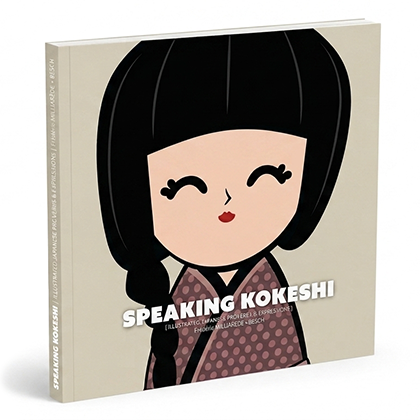
"Speaking Kokeshi" is a cultural project that combines visual elements of Japan 日本,
between kokeshi dolls こけし and proverbs (kotowaza) 諺, idioms, sayings, and lifestyle.
It is a collection of illustrated Japanese proverbs.
The collection started in May 2023.
New Kokeshi are published regularly.
The visuals are individually drawn.
The translation and explanation stem from research conducted to create the illustrations.
#005
Even the hardest of hearts can be moved to tears. 鬼の目にも涙
鬼の目にも涙 « Oni no me ni mo namida »
Literal: A tear in the ogre’s eye.
Meaning: Even the most ruthless people sometimes shed tears.
To understand what this proverb does, you have to know what an oni actually is. Not a devil in the Western sense, not a horror-film monster. The 「 oni 」 (鬼) comes from Japanese Buddhist cosmology: massive, club-wielding, red or blue-skinned, stationed at the gates of the underworld to judge the souls of the dead. It is the enforcer of consequences. It does not negotiate.
Every year at 「 Setsubun 」 (節分 the seasonal turning ceremony in early February), households across Japan still throw roasted soybeans to drive oni away, shouting 「 oni wa soto, fuku wa uchi 」 (鬼は外、福は内 demons out, good fortune in). The oni lives in daily life as the image of what cannot be softened. The proverb doesn’t say the oni becomes kind. It says a tear appears in its eye. The hardness remains. Something passes through it anyway.
The expression likely consolidated during the Edo period (1603–1868), when Buddhist moral literature circulated widely in popular form. It belongs to a family of 「 kotowaza 」 (諺, proverbs) that locate compassion in unexpected places, a recurring theme in a culture shaped by the Buddhist conviction that no being is entirely beyond the reach of 「 karuna 」 (悲 compassion).
Today the proverb is used about people, not creatures. The famously strict boss who tears up at a retirement party. The demanding parent who breaks down at a child’s graduation. The football coach whose players have never seen him anything but severe. It names the moment when someone’s constructed exterior gives way, briefly, to something underneath. There is no mockery in it. The tone is one of quiet relief.
Western readers have adjacent expressions, “ even the devil cries ” exists in several European languages, but they tend to carry a note of suspicion, as if the emotion revealed hidden weakness or manipulation. This proverb carries none of that. The tear in the oni’s eye is simply true.
It doesn’t explain the oni, and it doesn’t redeem it. It just means that hardness, however absolute it appears, is never the whole story.
Speaking Kokeshi#005 — Even the hardest of hearts can be moved to tears. — 鬼の目にも涙
Speaking Kokeshi started in May 2023 from a simple observation: Japan has one of the richest traditions of proverbial expression in the world, and most of it is either unknown outside the country or reduced to a handful of pop concepts stripped of their context.
The original idea was to adapt the tradition of 19th-century European talking plates to modern times — objects that carried a phrase, a face, a moral. The kokeshi doll was the right vehicle. Spare, distinctive, rooted in Japanese craft, it allows the illustration to carry meaning without excess.
Forty proverbs. Forty characters. Each drawn individually, each the result of research into the cultural and historical origins of the expression. Not a catalog. A book with a point of view.