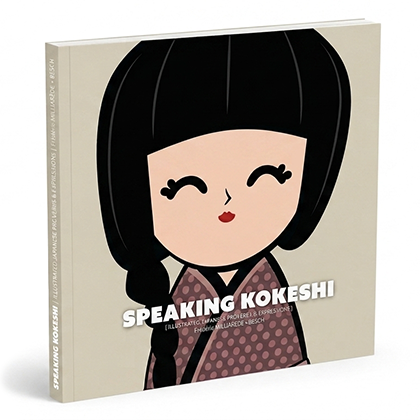
"Speaking Kokeshi" is a cultural project that combines visual elements of Japan 日本,
between kokeshi dolls こけし and proverbs (kotowaza) 諺, idioms, sayings, and lifestyle.
It is a collection of illustrated Japanese proverbs.
The collection started in May 2023.
New Kokeshi are published regularly.
The visuals are individually drawn.
The translation and explanation stem from research conducted to create the illustrations.
Literal: Even monkeys fall from the tree.
Meaning: Even experts make mistakes.
The monkey isn’t an arbitrary choice. In Japanese culture, monkeys carry real symbolic weight: they appear in Shinto iconography, and most famously in the three carved figures at Tōshō-gū shrine in Nikkō, the “ see no evil, hear no evil, speak no evil ” trio that has traveled far beyond its origins. The monkey stands for cleverness, agility, and a kind of practical intelligence. That’s exactly what gives this proverb its quiet force. If even the monkey, the creature most at home in the trees, can fall, then falling isn’t a failure of ability. It’s just part of the deal.
The saying likely took shape during the Edo period (1603-1868), in a society that placed deep value on craft and the slow accumulation of skill. For the 「 shokunin 」 (職人 master artisans) of that era, 「 saru mo ki kara ochiru 」 was a grounding reminder: years of practice don’t make anyone immune to the occasional slip. The stumble doesn’t erase the mastery. It proves it was real.
In Japan today, it still circulates naturally, especially in workplaces where the pressure to perform without fault runs high. When a senior colleague makes a mistake, someone younger might quietly invoke it, not as a jab, but to let the room breathe again. That’s a particular kind of cultural generosity. It connects to the wider sensibility of 「 wabi-sabi 」 (侘寂, the acceptance of imperfection and impermanence), a reminder that Japanese culture has long had a more honest relationship with failure than its precision-focused reputation might suggest.
Western readers have their own versions, “ even Homer nods ” being the oldest, but they tend to frame errors as exceptions, things to account for and move past. This proverb does something subtly different. It places the stumble inside the expertise itself. To be truly skilled is to have tried enough times that failure, eventually, becomes inevitable. The monkey doesn’t fall despite its ability. It falls because it never stops climbing.
Speaking Kokeshi#018 — Mastery does not provide immunity. — 猿も木から落ちる
Speaking Kokeshi started in May 2023 from a simple observation: Japan has one of the richest traditions of proverbial expression in the world, and most of it is either unknown outside the country or reduced to a handful of pop concepts stripped of their context.
The original idea was to adapt the tradition of 19th-century European talking plates to modern times — objects that carried a phrase, a face, a moral. The kokeshi doll was the right vehicle. Spare, distinctive, rooted in Japanese craft, it allows the illustration to carry meaning without excess.
Forty proverbs. Forty characters. Each drawn individually, each the result of research into the cultural and historical origins of the expression. Not a catalog. A book with a point of view.