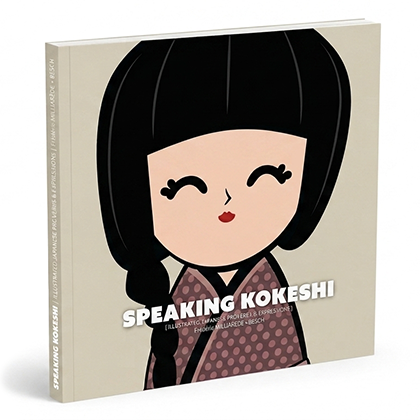
"Speaking Kokeshi" is a cultural project that combines visual elements of Japan 日本,
between kokeshi dolls こけし and proverbs (kotowaza) 諺, idioms, sayings, and lifestyle.
It is a collection of illustrated Japanese proverbs.
The collection started in May 2023.
New Kokeshi are published regularly.
The visuals are individually drawn.
The translation and explanation stem from research conducted to create the illustrations.
#012
There is more beyond what you know, stay curious. 井の中の蛙大海を知らず
井の中の蛙大海を知らず « I no naka no kawazu taikai wo shirazu »
Literal: The frog in the well knows nothing of the great ocean.
Meaning: A closed mind is limited by its own knowledge.
The image goes back to Zhuangzi, the Chinese philosopher of the fourth century BCE, where a frog boasts to a sea turtle about the pleasures of its well, only to go quiet when the turtle starts describing the ocean. Japan absorbed the fable through centuries of engagement with Chinese classical literature, and the phrase settled so deeply into the language that most Japanese speakers today would be surprised to learn it didn’t start there.
In both Confucian and Zen thought, the failure the frog represents isn’t stupidity. It’s the blindness that comes from never having been tested, from living in a world small enough that your own experience seems to cover it all. The well isn’t a prison. It’s comfortable and familiar and complete in itself, which is exactly the problem.
A longer version adds a twist: 「 saredo sora no fukasa wo shiru 」 されど空の深さを知る “ …but it knows the depth of the sky .” This addition likely has roots in medieval Zen poetry. What it brings in is not comfort but complication: the frog’s limitations are real, and so is its particular kind of knowledge. Looking straight up from the bottom of a well, you see a circle of sky that nobody standing in an open field ever sees quite the same way. Depth and breadth are not the same thing, and the proverb in its full form sits with that without trying to resolve it.
In Japan today, it gets used to name the gap between someone’s self-assessment and the wider world’s verdict. The young professional who hasn’t tested themselves outside their company, the student who excelled locally and struggles when the field widens. The second half tends to appear in more reflective conversations, often as a kind of rehabilitation for the specialist, the craftsman, the person who chose to go deep rather than wide.
Western readers will recognize the type immediately. Every culture has a version of the person who never left the village. What this proverb adds is the part most Western equivalents don’t have: the acknowledgment that the well, for all its limits, produces a view of its own.
Note: 全く for 全くもう 「 mattaku mô 」 on the dōgi (martial arts training uniform). Means “ Honestly, you know!!! ”. Often said when someone is exasperated, frustrated, or mildly annoyed.
Speaking Kokeshi#012 — There is more beyond what you know, stay curious. — 井の中の蛙大海を知らず
Speaking Kokeshi started in May 2023 from a simple observation: Japan has one of the richest traditions of proverbial expression in the world, and most of it is either unknown outside the country or reduced to a handful of pop concepts stripped of their context.
The original idea was to adapt the tradition of 19th-century European talking plates to modern times — objects that carried a phrase, a face, a moral. The kokeshi doll was the right vehicle. Spare, distinctive, rooted in Japanese craft, it allows the illustration to carry meaning without excess.
Forty proverbs. Forty characters. Each drawn individually, each the result of research into the cultural and historical origins of the expression. Not a catalog. A book with a point of view.